Best Land Investing Software in 2026: An Honest Comparison
Search for the best land investing software, and most of what comes back is an affiliate roundup.
A list assembled by someone who signed up for one platform, earned a commission on the link, and rated it a nine out of ten.
That is the backdrop worth keeping in mind before spending a dollar.
The second thing worth knowing is that there is no single winner.
The tools in this category were built to do different jobs, and the platform that is ideal for a high-volume mail operation in rural Texas is dead weight for an investor running careful title work on ten parcels a year.
The useful question is “best at what, for whom.”
What follows is a grounded look at the major options in 2026, where each one earns its price, and where it quietly falls short.
DataTree
A detail that surprises newer investors: several of the land tools being compared here are, underneath the interface, DataTree.
It is First American’s data, and it runs deeper on ownership and title than anything else in the category.
What it’s good at
Deeds, assessor maps, transaction history, and recorded document images at real depth
Portfolio-owner searches that surface every parcel a person holds nationwide
The category standard for title research and document-heavy due diligence
Where it stops
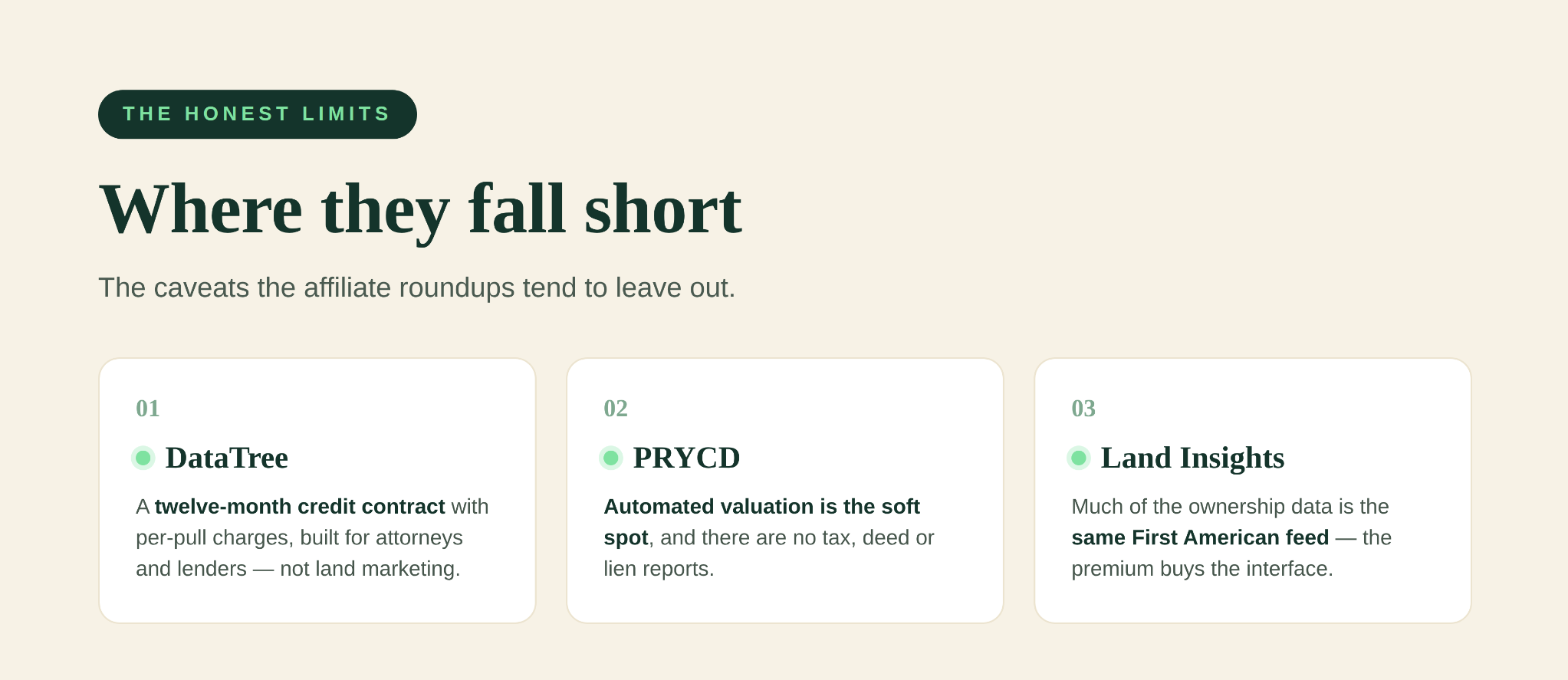
A twelve-month contract on a credit system, with per-pull charges that continue once credits run out
Filtering powerful to the point of being unwieldy, and data freshness that varies by county
Built for lenders, appraisers, and attorneys first; not shaped for land marketing
Best fit
Low-volume, document-heavy work like chains of title, deed images, verifying exactly what a seller owns.
PRYCD
PRYCD is a narrowly focused tool that removes the parts of land investing that used to consume whole afternoons: pulling owner records, scrubbing the junk out of a list, and pricing each parcel so the file exports are ready to mail.
What it’s good at
Licenses DataTree's data at scale and passes the low per-record rate down, with no long-term contract
Scrubs and prices a raw list against a set offer percentage in minutes
Exports up to 25,000 records at once, where DataTree caps nearer 10,000
Where it stops
Automated valuation is the soft spot, confident numbers built on comparables that don't hold up on inspection
No tax, deed, or lien reports, and no way to click a parcel on a map and pull its data
It scrubs and prices lists; it does not perform due diligence and makes no claim to
Best fit:
An active flipper who already knows their markets and needs lists pulled and priced fast.
Regrid
Regrid holds the parcels, roughly 150 million of them, with boundaries, ownership, and zoning, mapped cleanly and reachable through an API. It anchors a wider GIS tier: geothinQ layers flood, wetland, and elevation data across counties, and ArcGIS will do nearly anything in trained hands.
What it’s good at
Authoritative nationwide boundaries with an open API for building a custom stack
A clean data-and-mapping foundation for developers and data-oriented teams
Physical due-diligence overlays through the wider GIS tier
Where it stops
No CRM, no deal tracking, no pricing engine, no mail integration, Regrid says as much about its own scope
Priced for firms and professionals, with boundary accuracy that varies by jurisdiction
Raw material rather than a finished workflow; solo investors end up bolting several tools onto it
Best fit
A developer or data-minded team replacing the map-and-boundary layer, not the whole operation.
Land Insights
A newer wave, Land Insights foremost, with LandVision and others alongside, collapses a dozen browser tabs onto a single screen, and leans hardest on market selection: telling an investor which counties are actually worth the postage.
What it’s good at
MLS sold, pending, and active comps overlaid on the map, with AI-assisted comping to reduce guesswork
Market-selection intelligence that can meaningfully change how quickly an investor moves
Brings market research, comps, and mapping into one workspace.
Where it stops
Much of the ownership data is the same First American feed under half the category, so the premium buys the interface more than better records
Leans toward valuation and market analytics, the back half of a deal, over physical land screening
Priced for scaling operators, and LandVision in particular skews commercial, with a real learning curve
Best fit
An investor who wants comps and market intel in one place and already has sourcing handled.
Land Portal
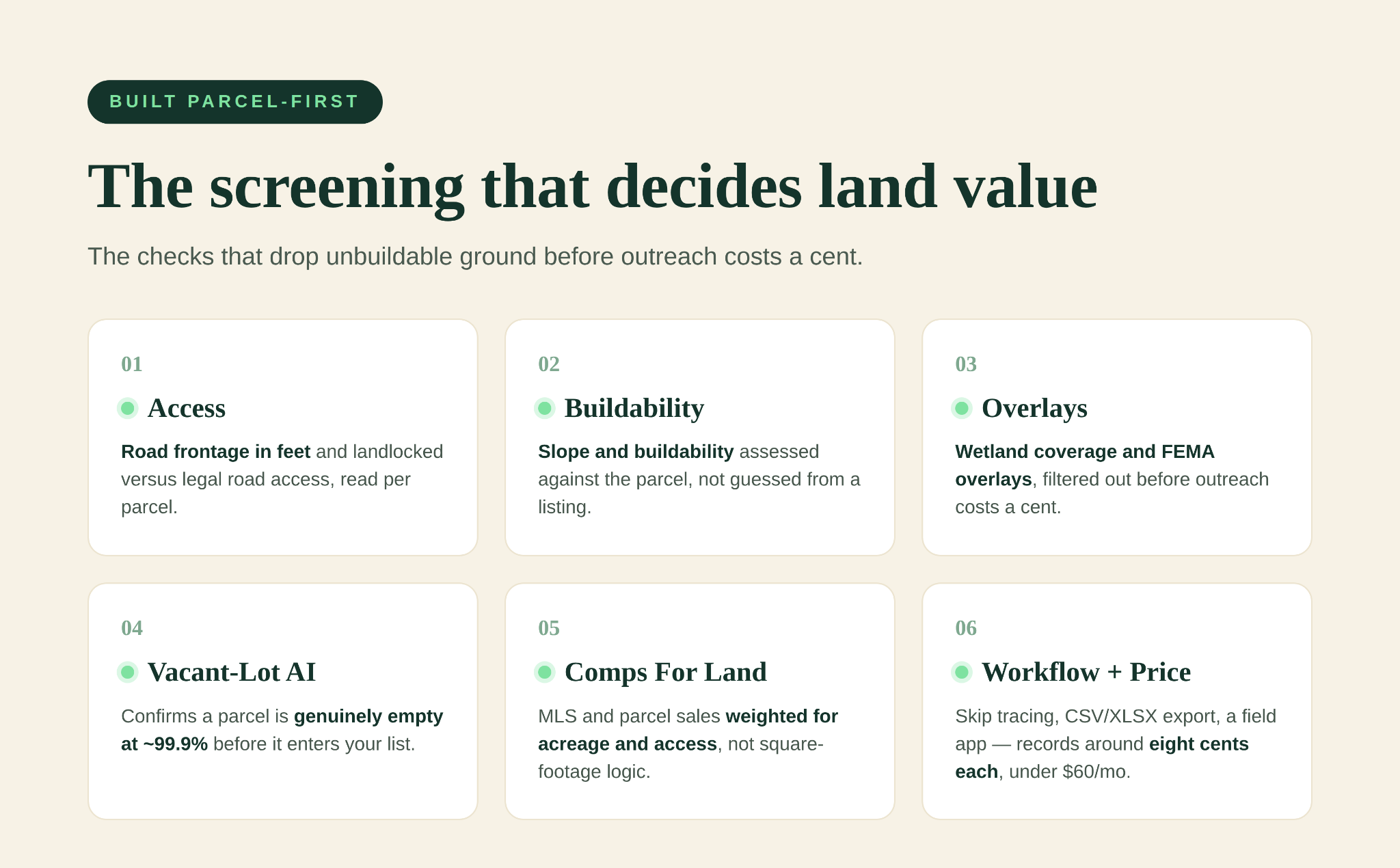
Where most of the field either provides data or analyzes markets, Land Portal is built around one specific job: finding and vetting rural vacant land, then pricing and exporting it. The full loop, parcel-first.
Land-Specific Research & Due Diligence
Road frontage in feet, landlocked versus legal road access, slope and buildability
Wetland coverage and FEMA overlays, filtered out before outreach costs a cent
AI Vacant Land filter that confirms a parcel is genuinely empty at approximately 99.9% accuracy
Comps built for land, not houses
MLS data and recent parcel sales tied to the property records, with an AI estimate weighted toward acreage, access, and buildability rather than square-footage logic borrowed from houses.
Workflow & Productivity
Skip tracing, CSV and XLSX export, and a mobile app for researching properties and reviewing parcels on the go
Skip tracing available with competitive per-record pricing.
For the specific task of building a qualified list of land investment opportunities in a target county, that combination is why a growing number of flippers consolidate onto thebest land software built around parcels from the ground up.
The honest limit is worth stating too: for work centered on recorded deed images and formal title chains, DataTree remains the stronger tool, and a parcel platform won’t replace it.
Best fit
An investor whose business lives on sourcing and vetting buildable rural land.
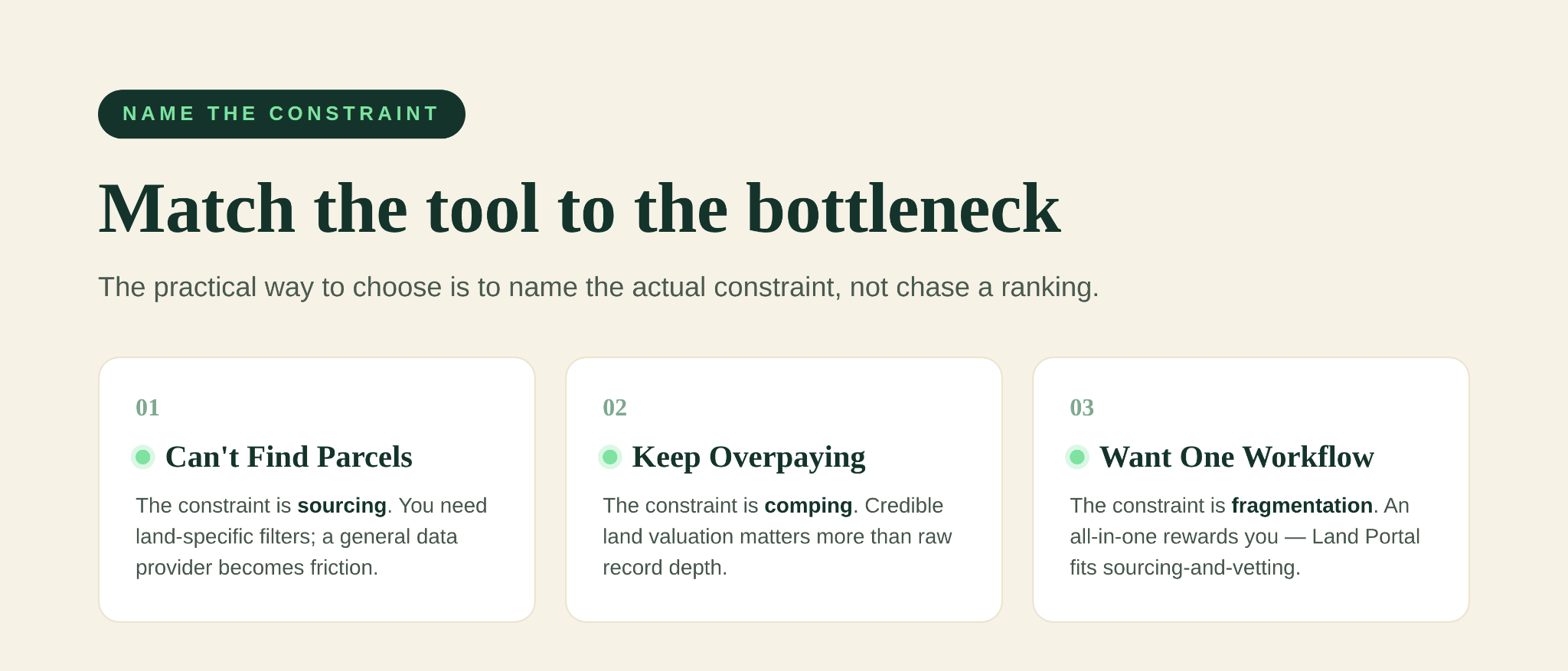
Match The Tool To The Bottleneck
The practical way to choose is to name the actual constraint rather than chase a ranking.
An investor who cannot find enough of the right parcels needs land-specific filters, and a general data provider will be a source of friction.
One who finds plenty but keeps overpaying has a comping problem, where a workflow platform with credible land valuation matters more than raw record depth.
The all-in-one platforms reward investors who value a single workflow, and Land Portal is the strongest fit for those whose business lives or dies on sourcing and vetting rural vacant land.
Choose against the bottleneck, verify current pricing before committing, and the ranking sorts itself out.