The Best DealMachine Alternative for Land Investors
DealMachine is one of the most popular tools in real estate investing, especially for wholesalers and residential investors.
While it includes property data, list building, skip tracing, and direct mail, its core workflow was designed around finding distressed houses, not vacant land.
For land investors, that difference matters. Evaluating vacant land requires market research, land-specific property filters, mapping, comparable land sales, and physical property analysis that go well beyond driving neighborhoods looking for distressed homes.
What DealMachine Is Actually Good At
DealMachine is a well-established platform for residential real estate investors, particularly wholesalers and house flippers.
The platform makes it easy to identify distressed properties, look up owner information, build targeted marketing lists, skip trace owners, and launch direct mail campaigns from one place. It also includes AI-powered features, automation tools, and a wide range of property filters designed for residential investing.
For investors focused on houses, it’s an efficient workflow. The challenge is that many of those tools are designed around evaluating buildings rather than vacant land.
Why Vacant Land Requires a Different Workflow
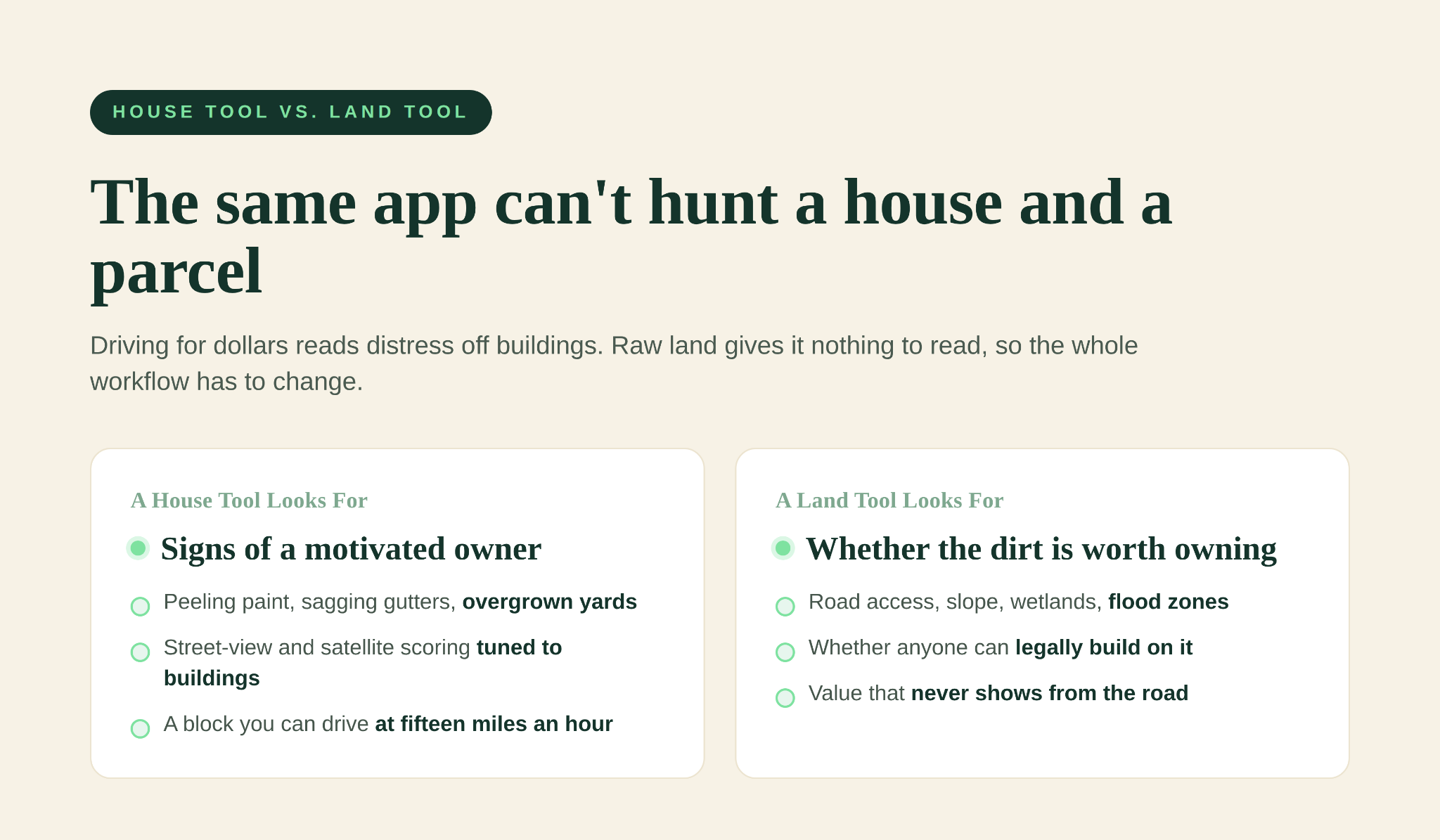
Driving for dollars is built around visually identifying distressed homes. Investors look for signs like overgrown yards, peeling paint, boarded windows, or deferred maintenance to identify potential opportunities.
Vacant land does not provide those same visual clues. Two neighboring parcels can look almost identical from the road while having completely different investment potential based on access, wetlands, slope, zoning, utilities, or buildability.
Because of that, successful land investing depends much more on property data and research than visual inspections alone.
So the core motion of the app has no surface to grip. You’re not scouting for neglect. You’re hunting for parcels that meet a set of physical criteria the app was never designed to know anything about.
Here’s the part that actually costs money.
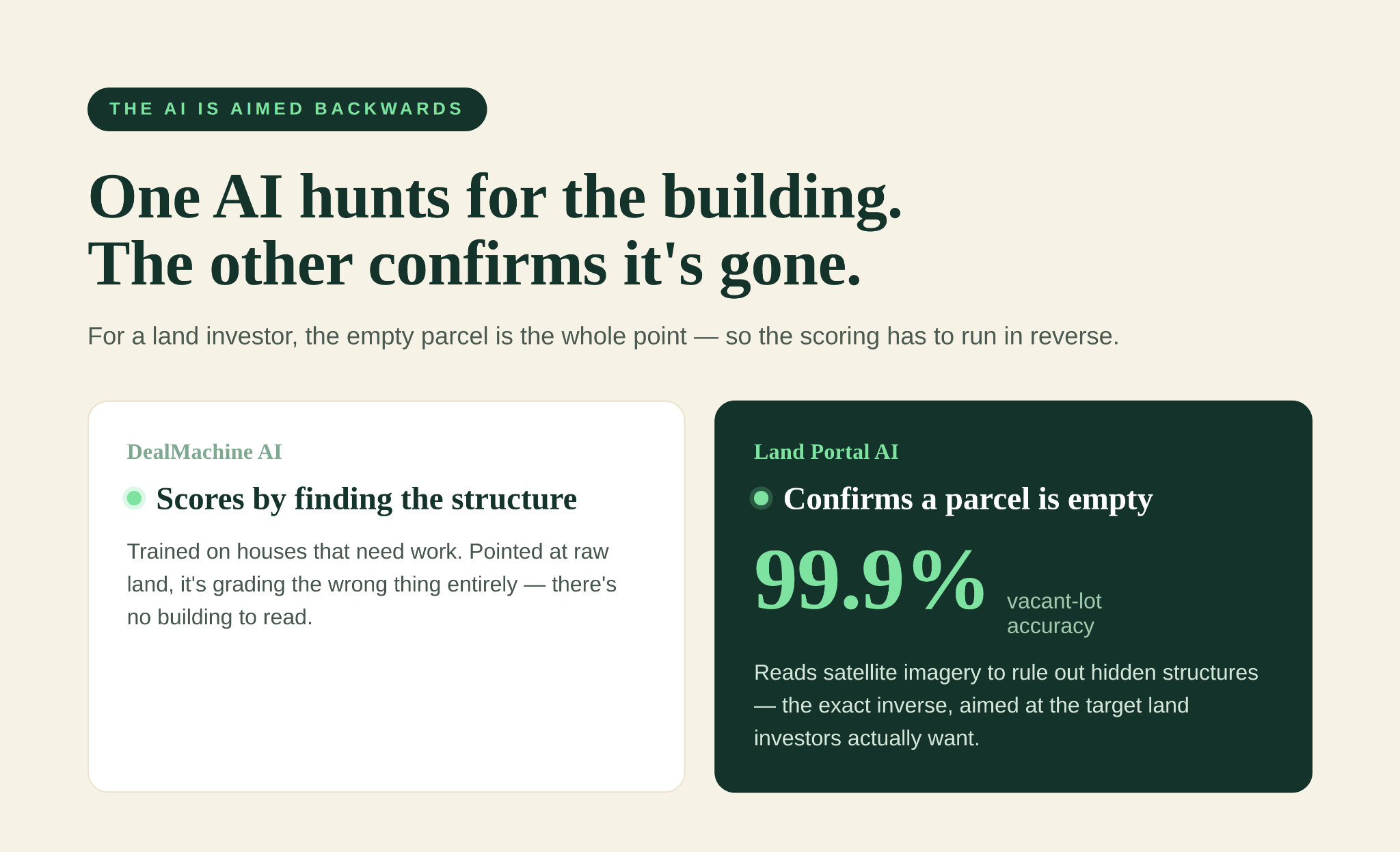
DealMachine’s AI is designed to help identify opportunities in residential real estate by analyzing houses and other visible property characteristics.
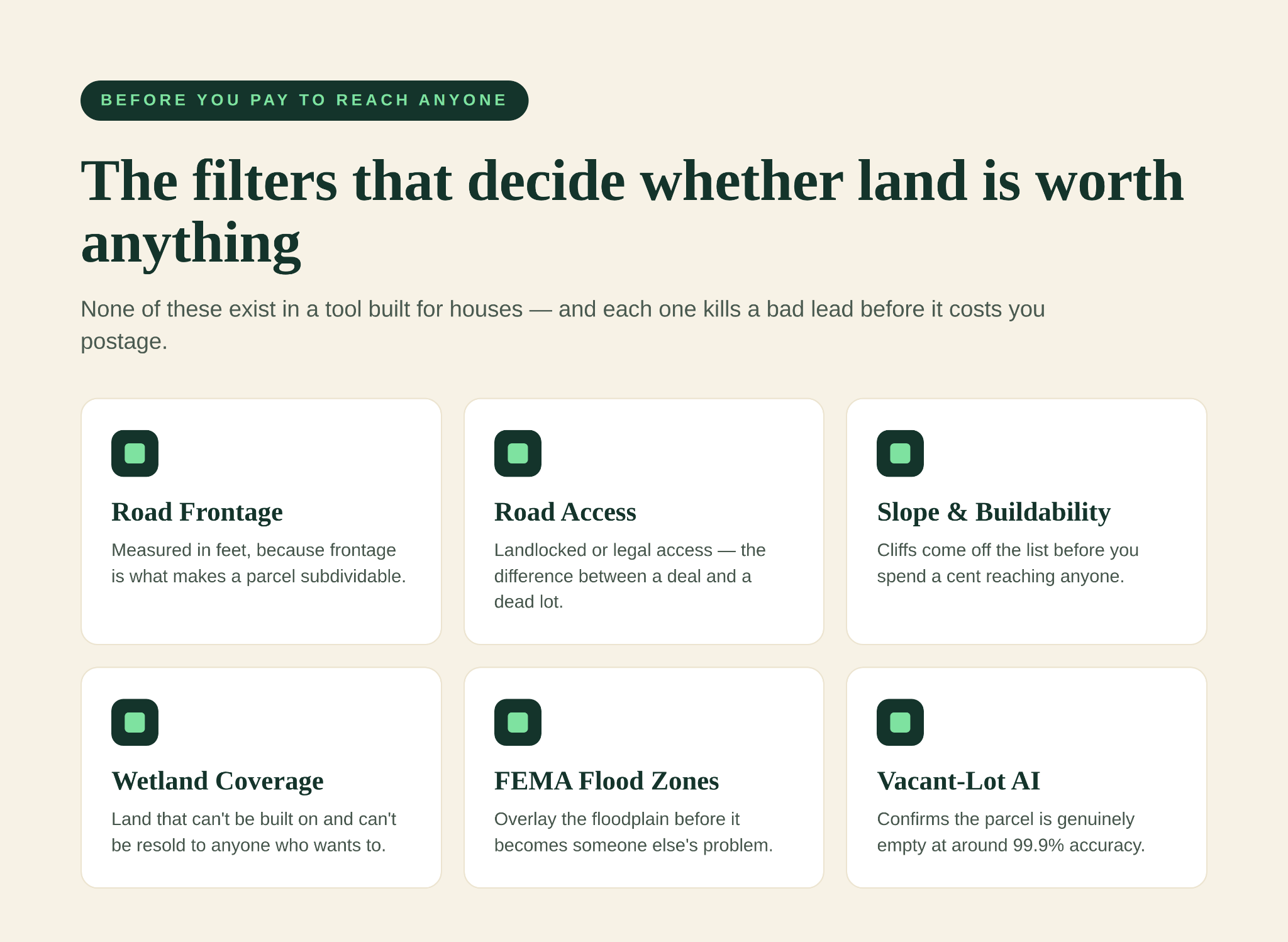
Land investing requires a different type of analysis. Instead of identifying distressed structures, investors first need to confirm that a parcel is actually vacant and then evaluate factors such as access, wetlands, slope, flood risk, utilities, and comparable land sales.
That is why many land-specific platforms focus their AI tools on evaluating vacant parcels rather than residential properties.
Three DealMachine Alternatives for Land Investors
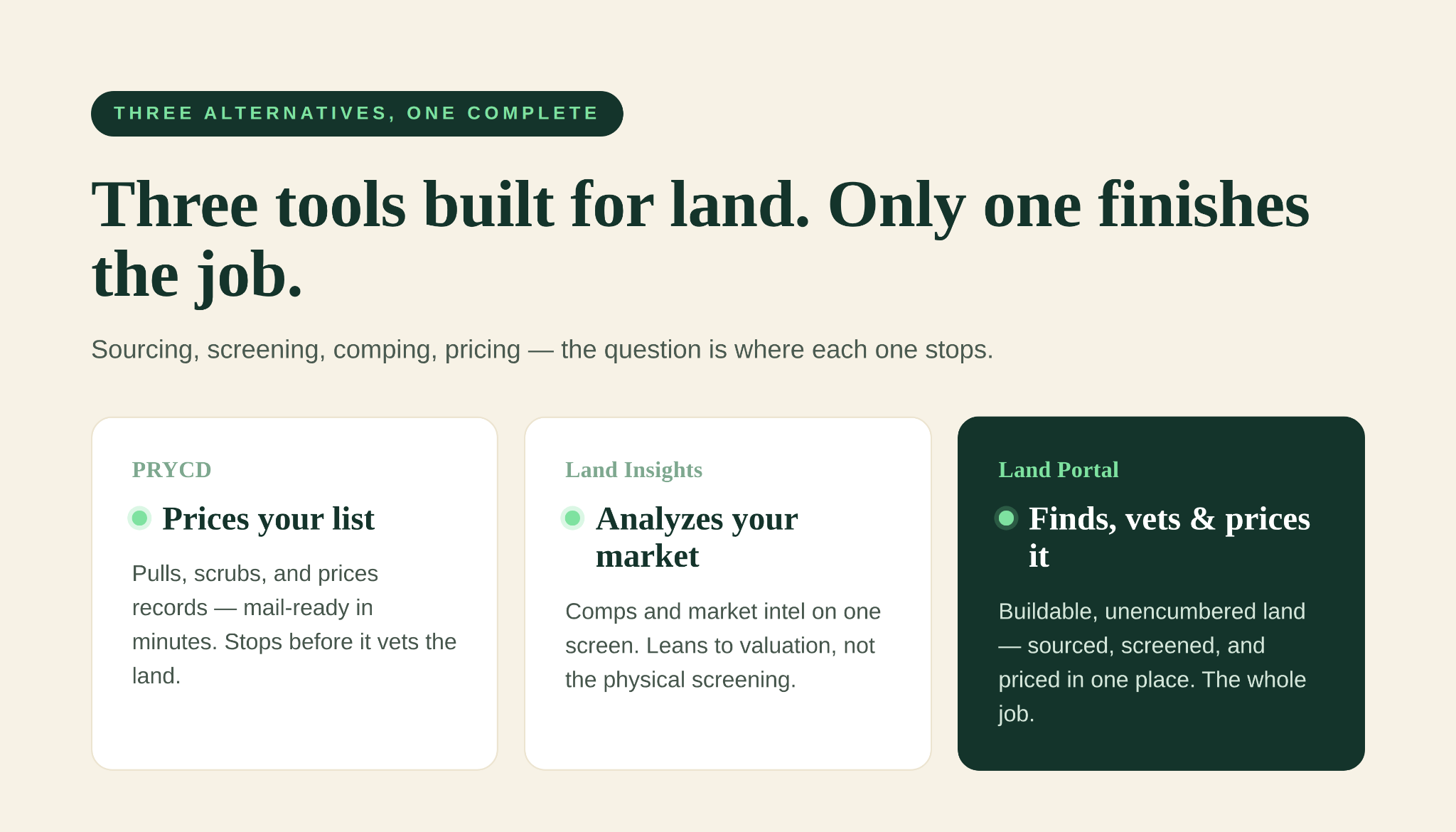
The land business has its own software, built by people who understand that a parcel is not a house. Three are worth knowing.
Each platform below is designed specifically for land investing, but they solve different parts of the workflow.
PRYCD
PRYCD is the closest thing to a straight swap for the DealMachine motion: pull a list, clean it, price it, mail it. It licenses First American data at scale, so records come cheap, and there’s no long contract.
What it does well
• Scrubs a raw file and applies an estimated offer price on every parcel by your chosen percentage, mail-house ready in minutes
• Cheap per-record pricing, no long-term commitment
• Exports up to 25,000 records at a time
Where it falls short
• Automated pricing should still be reviewed alongside comparable land sales and the physical characteristics of each parcel.
• No tax, deed, or lien reports
• No map view; you can’t click a parcel and pull its story
Best for:
An investor who already knows their market and just needs lists pulled and priced fast. Best suited for investors who already know their target markets and primarily need fast list building and pricing.
Land Insights
Land Insights is the serious contender. It collapses the work land investors used to scatter across Redfin, Zillow, DataTree, PropStream, and half a dozen browser tabs onto a single screen.
What it does well
• MLS sold, pending, and for-sale comps overlaid right on the map
• An AI comping tool that takes most of the guesswork out of offer prices
• Market-selection data for picking counties that won’t eat your postage
Much of that data is the same First American feed sitting under half the tools in this space, so the premium buys the interface and the comping workflow more than uniquely better records. And the platform leans toward valuation and market analytics, the back half of a deal, more than the physical land screening that decides whether a parcel is worth mailing in the first place.
Best for:
An investor who wants comps and market intel in one place and already has sourcing handled.
Land Portal
The one built around the exact problem this article started with.
Remember the DealMachine AI that scores properties by hunting for the building?
Land Portal reads satellite imagery to do the opposite. It confirms a parcel is genuinely empty (no hidden mobile home, no shed, no structure) at around 99.9% accuracy. For a land investor, that is the entire game. It’s the single feature that most cleanly inverts a house tool and points it at the right target.
• Mobile access for researching properties in the field.
• Multiple subscription options for solo investors, growing teams, and higher-volume businesses.
That combination is why land flippers keep landing on software built parcel-first instead of house-first. And it doesn’t stop at the software: the platform pairs with structuredland investing education through its own university, so a beginner isn’t handed a powerful tool with no sense of which markets are worth the postage or how an access easement can quietly wreck a deal.
Best for:
Land investors who want market research, land-specific filters, mapping, comps, owner data, and outreach tools in one connected platform.
The Bottom Line
DealMachine is an excellent platform for residential real estate investors, particularly those using a driving-for-dollars strategy.
Land investing requires a different approach. Success depends on evaluating the property itself, access, buildability, wetlands, flood risk, comparable land sales, and other land-specific characteristics, before contacting the owner.
Choosing software built specifically for land investing can make researching properties, building mailing lists, and evaluating deals more efficient while helping investors focus on higher-quality opportunities.