Direct Mail Marketing for Land Investors: The Complete Playbook
Direct mail remains one of the most effective marketing channels for land investors.
Unlike many forms of digital advertising, direct mail allows you to reach property owners who may not actively be looking to sell but are open to the right offer.
Successful mail campaigns rarely come down to the letter itself. Results are driven by the quality of your mailing list, accurate property data, consistent follow-up, and disciplined tracking.
This guide walks through the key parts of building a direct mail campaign that consistently generates land opportunities.
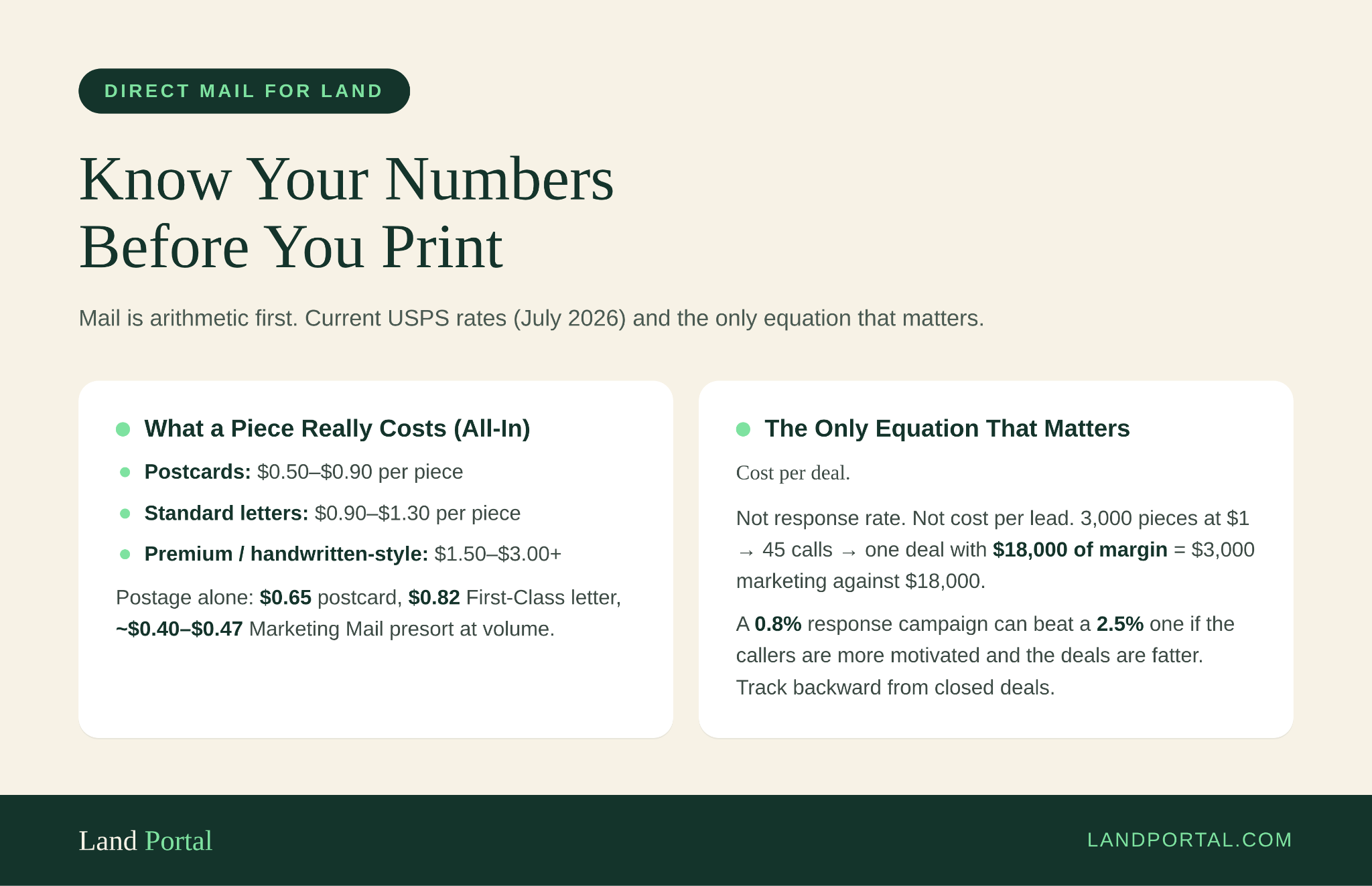
Know Your Numbers Before You Print Anything
Before sending your first mail campaign, understand what each piece costs and how those costs translate into closed deals.
Current postage reality
As of the July 12, 2026 USPS rate change, a First-Class postcard costs $0.65 and a 1-ounce letter runs $0.82 with a Forever stamp.
If you’re mailing at volume, presort changes the math: presorted First-Class letters start around $0.525 at the 5-Digit automation level, and Marketing Mail runs $0.395 to $0.467 per letter depending on presort tier.
Your mail house handles the sorting; you just need to know these tiers exist so you don’t pay retail on 5,000 pieces.
All-in, with printing and list costs folded in, budget roughly:
• Postcards: $0.50-$0.90 per piece at typical volumes
• Standard letters: $0.90-$1.30 per piece
• Handwritten-style or premium pieces: $1.50-$3.00+
The only equation that matters
While response rates are useful, cost per closed deal is the metric that matters most.
A campaign with fewer responses can outperform one with a much higher response rate if the leads are better qualified and result in more profitable acquisitions.
Track every campaign from the initial mailing through closed transactions so you can identify which lists, markets, and strategies produce the best long-term results.
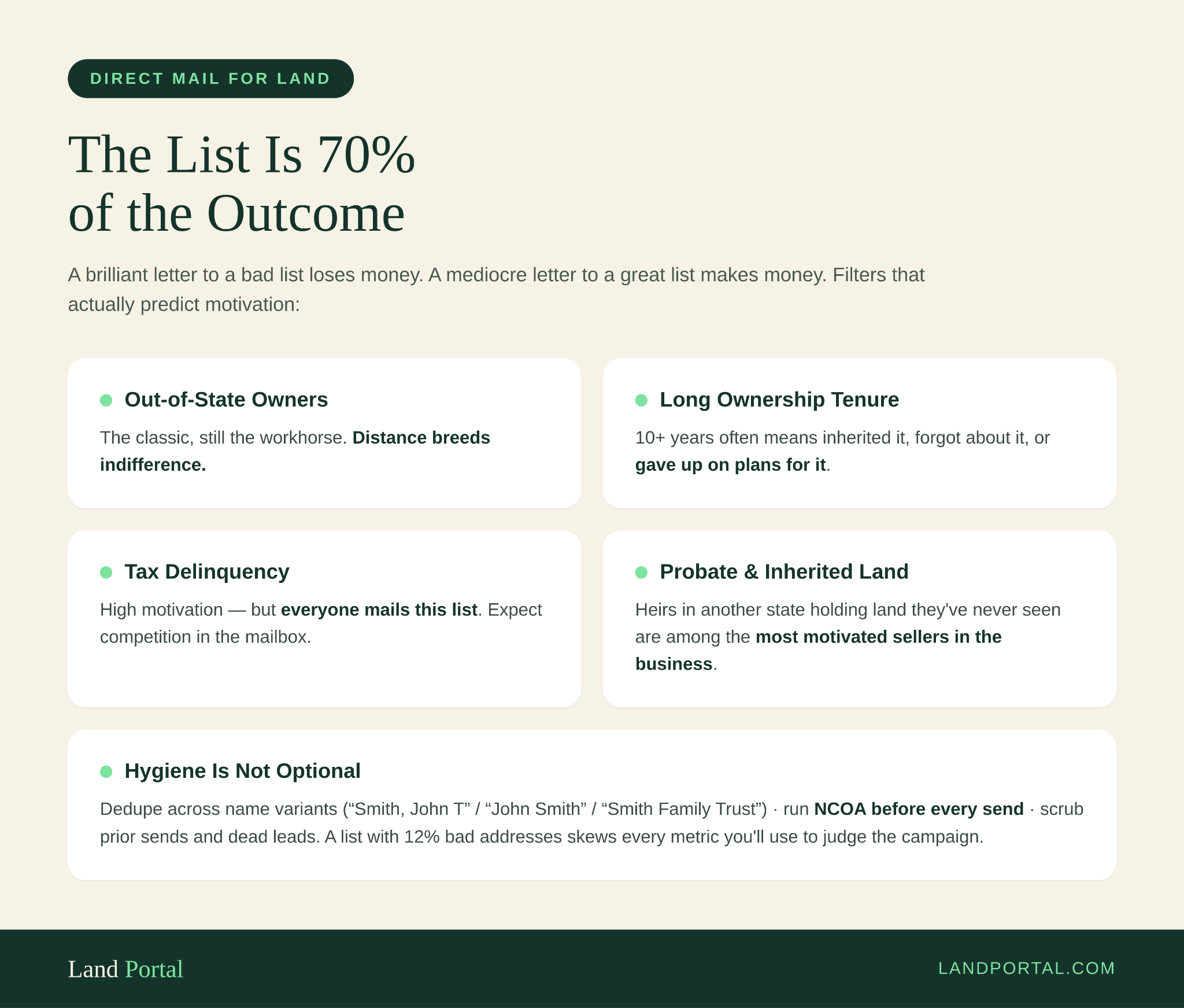
The List Is 70% of the Outcome
The quality of your mailing list has a greater impact on campaign performance than almost any other factor.
Where land lists come from
County assessor data is the raw material: every parcel, every owner, pulled either directly from county records or through a data platform that aggregates them.
If you’re pulling and filtering these yourself, expect to spend real time cleaning; if you’re using software, the filtering is faster, but the data quality varies platform to platform, and outdated ownership information can reduce deliverability and campaign performance.
Filters that actually predict motivation:
• Out-of-state or out-of-county owners. Owners who live outside the area are often more willing to sell vacant land they no longer use.
• Long ownership tenure. Long-term ownership can sometimes indicate owners who no longer have plans for the property.
• Tax delinquency. Tax-delinquent properties can indicate motivated sellers, although these lists are often highly competitive.
• Absentee owners with multiple parcels. One yes can become three deals.
• Recently probated or inherited property. Heirs in another state holding land they’ve never seen are among the most motivated sellers in this business.
Keep Your Mailing Lists Clean
Dedupe across owner name variants, “Smith, John T” and “John Smith” and “Smith Family Trust” holding adjacent parcels are often the same decision-maker, and mailing them three identical letters reads as spam.
Run NCOA (National Change of Address) processing before every send. Scrub against your previous sends, your do-not-mail requests, and your dead leads.
A list with 12% undeliverable addresses isn’t just wasted postage; it’s skewing every metric you’ll use to judge the campaign.
Ownership information changes regularly as properties are bought, sold, inherited, or transferred.
Before choosing a data provider, understand how frequently ownership records are refreshed and how quickly new county data becomes available. More current data generally leads to better mailing accuracy.
Choose Your Weapon: Postcard, Letter, or Offer
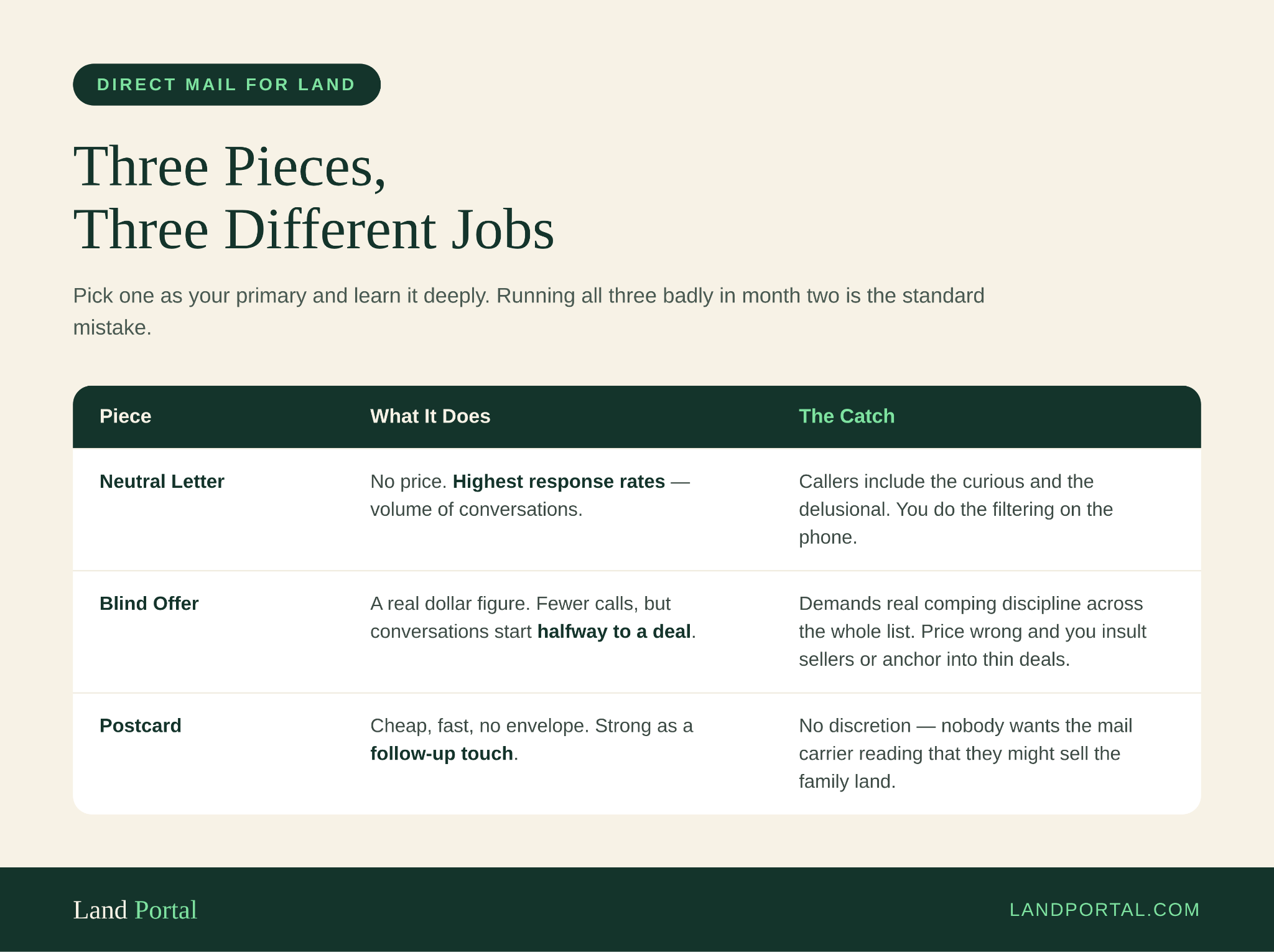
Most land investors rely on one of three primary direct mail formats.
The Neutral Letter
A neutral letter simply expresses interest in purchasing the owner’s property without including an offer price.
This format often produces the highest response volume because owners are encouraged to start a conversation before discussing price.
It works well for investors who are comfortable qualifying leads and negotiating offers over the phone.
The Blind Offer
Blind offer letters include a proposed purchase price.
While response rates are generally lower than neutral letters, the conversations that do occur are often more qualified because the owner has already considered the offer amount.
This strategy works best when supported by accurate land valuation and comparable sales data.
The Postcard
Postcards are inexpensive to produce and work well for follow-up campaigns or lower-value markets.
Because the message is visible without opening an envelope, postcards may be less appropriate when privacy is important or when marketing higher-value properties.
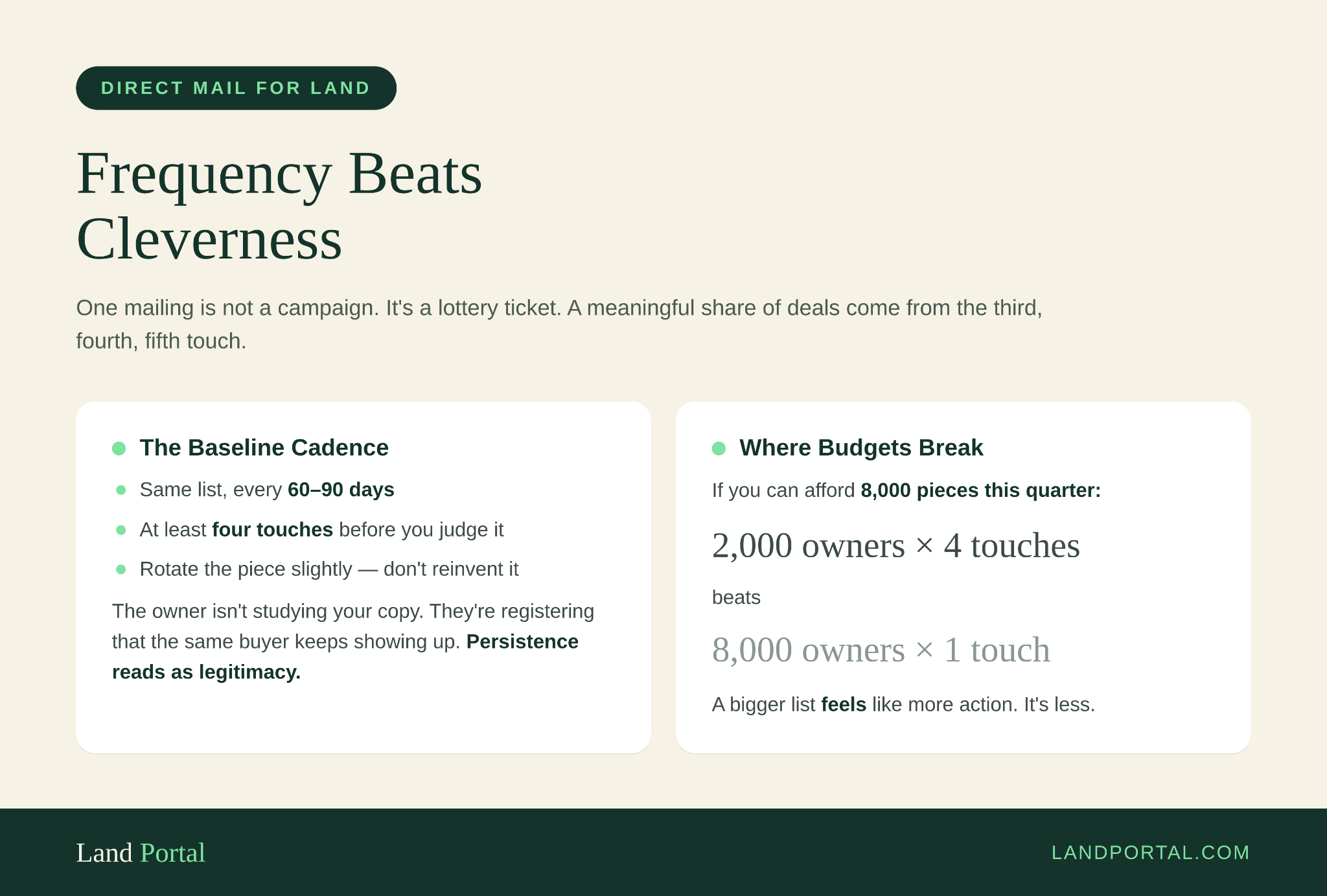
Consistency Matters More Than Creativity
Many successful land investors report that a significant percentage of deals come after multiple mailings to the same owner.
Property owners’ circumstances change over time, and consistent follow-up helps ensure your offer is received when they’re ready to consider selling.
A workable baseline: same list, every 60-90 days, for at least four touches before you judge it. Rotate the piece slightly between sends, different opening line, different format, but don’t reinvent it.
Consistent communication helps build familiarity and increases the likelihood that an owner will contact you when the timing is right.
If your budget is limited, mailing a smaller group of owners multiple times is often more effective than mailing a much larger list only once.
Answer the Phone Like the Campaign Depends on It
Intake is the most neglected part of the entire system and the cheapest to fix.
Responding quickly to inbound calls can significantly improve conversion rates.
There’s always a next letter, your competitors mailed the same tax-delinquent list you did. Live answer, whether that’s you, a VA, or an answering service with a decent script, converts measurably better than callback workflows.
If you must use voicemail, the message should sound like a person, name the county (“Hi, you’ve reached ___ about your property in ___ County”), and promise a same-day callback that actually happens.
Log every call against the campaign and list segment it came from. Owner name, parcel, source list, disposition. Three months from now, this log is the only honest record of what’s working, and it’s how you find out that your out-of-state absentee list outperforms your tax-delinquent list two-to-one on actual closings despite pulling fewer calls.
Test, Measure, and Improve
Every market is different, so no direct mail strategy should be treated as universal.
Test one variable at a time, such as the list, mail piece, or offer strategy, and allow enough volume to produce meaningful results.
When a campaign consistently performs well, focus on scaling it before making additional changes.
Small, measured improvements over time generally outperform constantly rebuilding successful campaigns.
Direct mail continues to be one of the most reliable lead generation strategies for land investors.
Success comes from combining high-quality data, thoughtful list selection, consistent follow-up, and careful measurement. When those pieces work together, direct mail can become a predictable source of new opportunities year after year.