The State of Land Investing 2026: Where Margins Went
Land investing continues to evolve as technology, market conditions, and investor competition change.
While many of the fundamentals remain the same, successful investors are placing greater emphasis on market research, property analysis, and data-driven decision-making before launching marketing campaigns.
This report looks at several trends shaping land investing today and how those changes are influencing the way investors research markets, evaluate properties, and build acquisition strategies.
Where Opportunities Are Changing
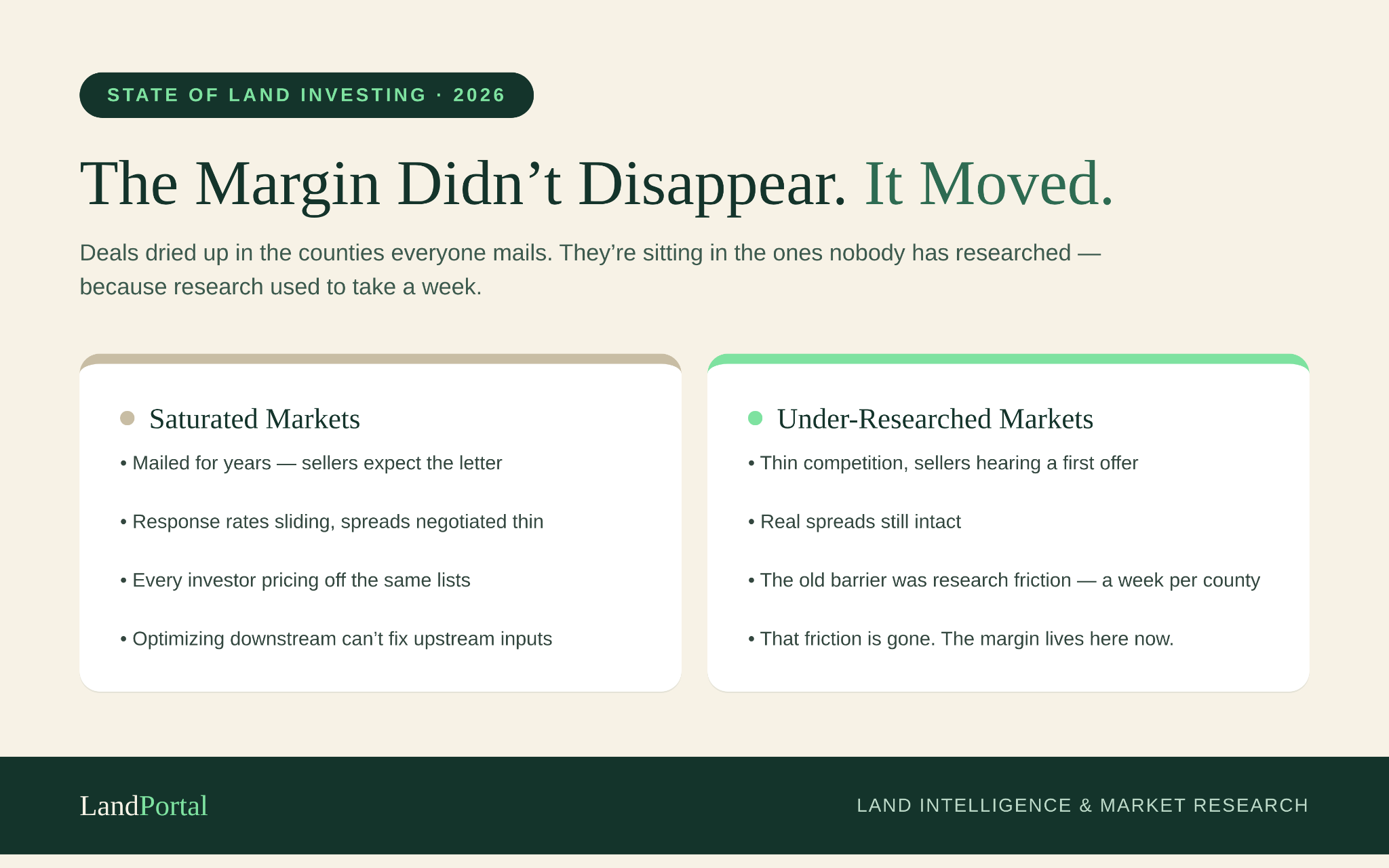
Many investors feel that finding profitable land deals has become more competitive in well-known markets.
Counties that have attracted large numbers of investors over the past several years often experience more competition, making it more difficult to consistently acquire properties at deep discounts.
At the same time, opportunities continue to exist in less competitive markets where fewer investors are actively marketing to property owners.
As market research tools have improved, evaluating unfamiliar counties has become faster and more practical, making it easier for investors to expand beyond the markets they have historically targeted.
Choosing the Right Market
One of the most important decisions investors make is choosing where to market.
Market selection influences acquisition costs, response rates, resale activity, and overall profitability long before the first mail campaign is launched.
Investors who regularly evaluate new markets may discover opportunities that receive less competition than long-established target counties.
Modern research tools make it possible to evaluate sold land activity, pricing trends, inventory, and comparable sales much more quickly than in the past.
That allows investors to compare multiple markets efficiently before deciding where to invest their marketing budget.
You can take a county you’ve never touched, pull sold comps, look at price-per-acre distributions by size bracket, check how fast inventory moves, and know within an hour whether it deserves a mail campaign. That used to be a week of tab-juggling across county sites, Redfin, and a spreadsheet.
Speed of market evaluation compounds. An investor who can vet a market in an hour will test twelve markets while the competition is still committed to the two they picked in 2022. Some of those twelve will be duds. Two or three won’t be. That’s the edge.
Market conditions also change over time. Monitoring sales activity, inventory levels, and pricing trends can help investors decide when it’s time to reduce activity in one market and begin testing another.
Most investors aren’t watching. They notice a market died about eight months after it died, which is roughly the cost of two failed mail campaigns.
Reviewing Comparable Land Sales
Pricing vacant land remains one of the most challenging parts of the acquisition process.
Unlike residential real estate, vacant land often varies significantly based on road access, terrain, wetlands, utilities, zoning, parcel shape, and other characteristics.
Reviewing comparable land sales alongside mapping and parcel data helps investors make more informed pricing decisions and reduces the likelihood of relying on inappropriate comparable properties.
LP Intelligence
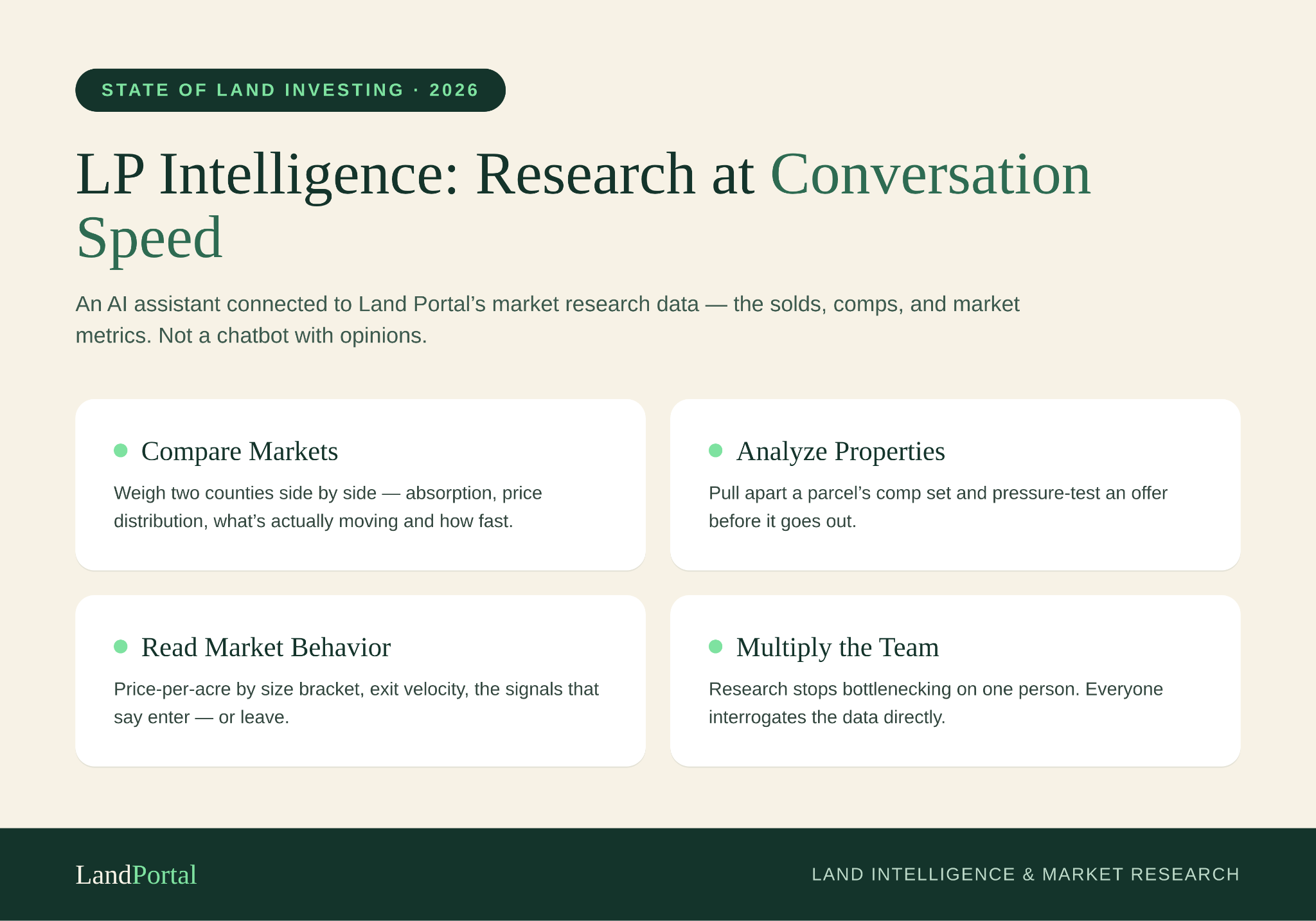
LP Intelligence is Land Portal’s AI-powered research assistant.
The important detail is what it’s connected to. This isn’t a chatbot bolted onto a website that gives you generic land-investing advice.
LP Intelligence sits on top of Land Portal’s actual market research data: the solds, the comps, the market metrics, the parcel records.
Investors can use LP Intelligence to compare markets, analyze parcel data, review comparable sales, and evaluate pricing ideas using the same research data already available inside the platform.
Rather than replacing investor judgment, it helps organize and accelerate the research process.
It’s early, and anyone who tells you AI replaces judgment in this business is selling something. But as a force multiplier on research, As AI capabilities continue to improve, these tools have the potential to make property research faster and more accessible for investors.
The Importance of Accurate Property Data
Accurate property data plays an important role in every stage of the acquisition process.
Before choosing a software platform, investors should understand how ownership records, parcel information, and mapping data are maintained and updated.
• Ownership records that reflect the current owner and not the one from two transfers ago.
• Acreage that matches the assessor.
• Parcels that geocode to the right polygon instead of the neighbor’s.
Land-specific property filters can also improve list quality by helping investors identify parcels that match their acquisition criteria before exporting records or launching direct mail campaigns.
Better targeting often results in more efficient marketing and fewer unnecessary mailings.
Mapping and Property Research
Mapping plays an important role in evaluating vacant land.
Viewing parcel boundaries, terrain, road access, and comparable sales together provides additional context that may not be obvious from tabular property data alone.
Bringing those research tools together into one workflow can make due diligence faster and more efficient.
Direct Mail and Owner Outreach
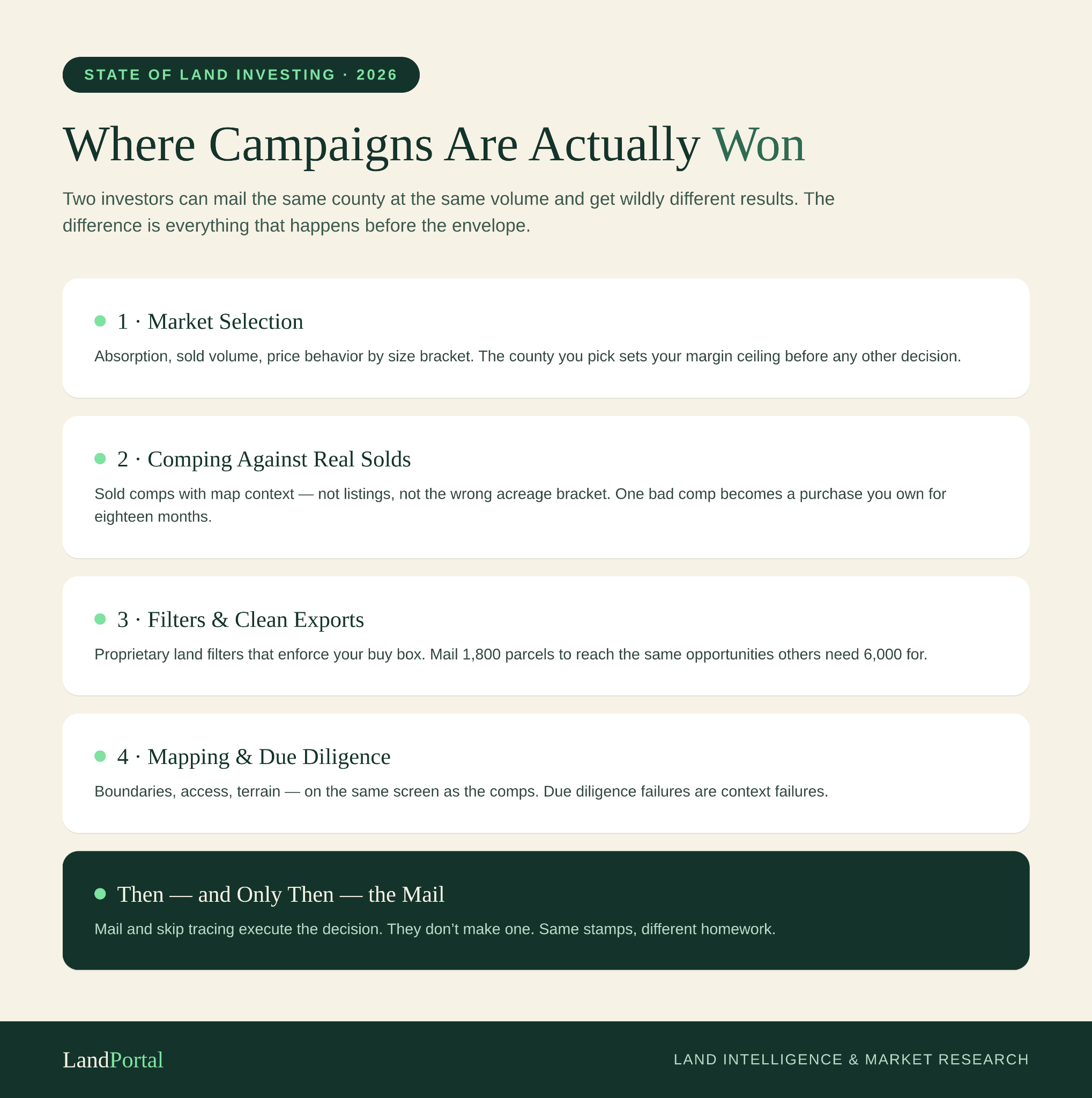
Direct mail still works. Skip tracing still works. Neither is a differentiator anymore, and the sooner an investor internalizes that, the better their year goes.
Ten years ago, being willing to mail at volume was the edge, most landowners had never received an offer, and the investors who showed up first won. Now the mail itself is commoditized. Everyone’s letters look similar, everyone’s using comparable list sources, and the seller’s mailbox is the most competitive channel in the industry.
Land Portal supports both mail and skip tracing, and they’re solid, but they’re downstream features. They execute a decision. They don’t make one.
The decision is where campaigns are won, months before the first envelope is printed.
Two investors can mail the same county in the same month, and the one whose list was built on better research and tighter filters will do multiples of the other’s deal flow at the same mail spend.
Trends to Watch
As research tools continue to improve, investors can evaluate more markets in less time than ever before.
AI-assisted analysis, improved mapping, and better access to comparable land sales are making it easier to identify opportunities and make more informed acquisition decisions.
At the same time, increasing competition in well-known markets may encourage more investors to explore counties they previously overlooked.
While the tools available to land investors continue to evolve, the fundamentals remain the same: understanding the market, evaluating properties carefully, and making informed acquisition decisions.
Investors who consistently improve their research process will be better positioned to adapt as market conditions continue to change.
Land Portal combines market research, land-specific property filters, mapping, nationwide MLS land comps, LP Intelligence, owner data, skip tracing, and Land Portal University in one platform built specifically for land investors.
Whether you’re evaluating a new market or pricing your next acquisition, every stage of the research process is connected in one workflow.