


Log in
The Best Land Investing Software for Beginners
Beginners often focus on software that helps them send mail, skip trace owners, or manage leads before they’ve built a strong process for choosing markets and evaluating properties.
Those outreach tools are useful, but they work best after you already know where you want to invest, which properties fit your criteria, and what those properties are worth.
That’s why the best land investing software for a beginner isn’t necessarily the tool with the most automation. It’s the tool that helps you make better decisions before you start spending money on data, marketing, and follow-up.
Early on, software should help you answer three basic questions:
• Where should I be looking?
• What is this property worth?
• Is there anything about this parcel that makes it a bad fit?
Once you can answer those consistently, the rest of the workflow becomes much easier to build.
What Beginners Usually Buy First
Direct mail, skip tracing, CRMs, and dialers are often some of the first tools beginners hear about.
Those tools help you execute a marketing campaign, but they don’t tell you whether you chose the right market or targeted the right properties.
That distinction matters.
A clean mailing campaign sent to poorly selected parcels is still a poor campaign. A skip trace can help you reach an owner, but it can’t tell you whether the property is one you should be pursuing in the first place.
For a beginner, the more important foundation is learning how to:
• Research a market
• Find properties that fit your criteria
• Evaluate comparable land sales
• Review access, terrain, flood zones, wetlands, and other property characteristics
Marketing tools become much more useful once those decisions are already being made well.
The 3 Things Beginner Land Software Should Help You Do
Before adding a long list of subscriptions, make sure your core software can help with three things:
1. Research the market.
Understand whether the counties and acreage ranges you’re considering have enough sales activity and buyer demand.
2. Evaluate the property.
Review recent comparable land sales and understand what similar properties are actually selling for.
3. Screen for potential problems.
Check characteristics such as road access, slope, wetlands, flood zones, and other issues that may affect usability or resale.
For a beginner, having those three steps in one workflow can be much easier than piecing together several different tools before you fully understand how each part of the business works.
Start With Market Research, Not a Mailing List
One of the biggest mistakes beginners can make is choosing a market before understanding how land is actually selling there.
A county may look active because it has a lot of listings, but that doesn’t necessarily mean buyers are closing on similar properties at a healthy pace.
The more useful question is whether the type of land you plan to buy is selling consistently in that market.
Before building a mailing list, look at:
• Sold volume within your target acreage range
• Active inventory
• Days on market
• Price per acre for similar properties
• Recent pricing trends
• Local zoning or subdivision rules that could affect your exit
• Ownership characteristics relevant to your acquisition strategy
Land Portal’s market research tools are designed to help investors compare markets using this type of information before committing marketing dollars.
For a beginner, that means you can start with actual market activity instead of choosing a county based only on low land prices, a recommendation from another investor, or the number of properties currently listed.
Learn to Comp Land Before You Automate Pricing
One of the most important skills a new land investor can learn is how to evaluate comparable sales.
Vacant land is harder to comp than a house because there are fewer standardized features and, in many rural markets, fewer recent sales.
Two parcels with similar acreage can still have very different values because of:
• Road access and frontage
• Utilities
• Slope and terrain
• Wetlands and flood zones
• Water or septic considerations
• Zoning
• Parcel shape and usable acreage
Parcel size matters too. A smaller property may sell for more per acre than a much larger tract in the same market, so one county-wide price-per-acre number is rarely enough.
Start with recent sold properties that are as similar to the subject parcel as possible, then review the differences before deciding where the property fits within the range.
Land Portal’s comping tools let you research nearby sold land, narrow results by acreage and other criteria, and review the comparable properties alongside the parcel you’re evaluating.
For a beginner, the goal isn’t to automate judgment away. It’s to build the habit of checking real sold data before making an offer.
How LP Intelligence Can Help Beginners Research Faster
One of the hardest parts of being new to land investing is not always knowing which questions to ask.
LP Intelligence is Land Portal’s AI-powered research assistant. It works with the property and market data inside the platform, giving investors another way to research markets and individual parcels using plain-language questions.
For example, a beginner might ask:
• Which markets have stronger sales activity for the acreage range I want to buy?
• Which markets have stronger sales activity for the acreage range I want to buy?
• What recent sold properties should I look at when comping this parcel?
• How does the asking price compare with similar sales?
• What should I look at next when evaluating this market?
The biggest benefit for beginners is that LP Intelligence can make it easier to explore the data and learn what information matters without rebuilding a new search every time another question comes up.
It doesn’t replace learning how to research and evaluate land. It gives you a faster way to work through that research.
Use Filters Built for Vacant Land
Generic real estate databases can usually filter by basic characteristics such as acreage, location, and ownership.
Vacant land investors often need more specific information because physical property characteristics can determine whether a parcel is worth pursuing at all.
Land Portal includes land-specific filters for things such as:
• Road frontage
• Landlocked properties
• Slope
• Wetlands
• FEMA flood zones
• Vacant land
• Ownership characteristics
• Acreage
The value comes from combining those filters to build a more targeted list before spending money on skip tracing, mail, or other outreach.
For a beginner, that can make it easier to understand why one parcel belongs on a mailing list while another should be removed before the campaign ever starts.
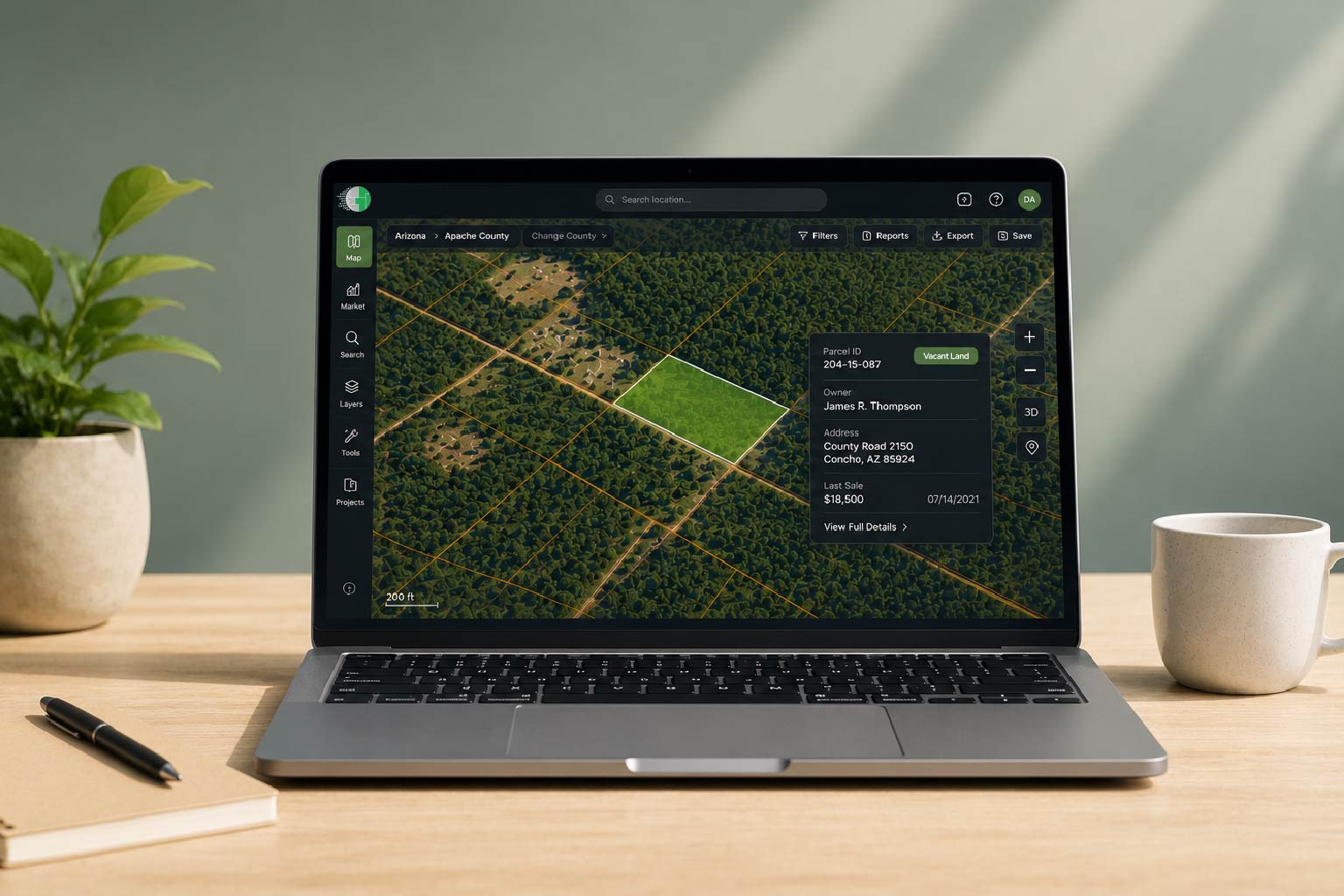
Use Mapping Before You Make an Offer
Mapping is another important part of evaluating vacant land.
Before making an offer, review the parcel using available data and mapping overlays to look for potential issues such as:
• Road access
• Parcel boundaries
• Terrain & slope
• Wetlands
• FEMA flood zones
• Water features
• Surrounding land uses
Land Portal brings mapping and property data into the same workflow as market research and comps, which makes it easier to screen a property while you’re already evaluating the deal.
This doesn’t replace a survey, county verification, soil testing, or an on-site visit when those are necessary. It helps you identify obvious concerns earlier.
The same mapping information can also be useful when marketing the property later by helping buyers understand boundaries, access, terrain, and other features.
Make Sure the Property Data Is Current and Usable
Property and ownership data changes over time.
Properties sell, mailing addresses change, ownership records are updated, and new listings or sales become available.
That’s why beginners should pay attention not only to how much data a platform offers, but also to how current the information is and whether they can actually use it in their workflow.
Land Portal refreshes available property, ownership, listing, and other data regularly as new information becomes available.
Export tools also matter once you begin working with larger lists, CRMs, mail houses, or partners.
Being able to take the properties you researched and move them into the next step of your business makes the data much more useful.
Popular Land Investing Software for Beginners
Most beginners will encounter the same handful of names. They’re built for different jobs, and the differences matter more than the feature counts suggest.
Land Portal
Land Portal is built specifically for land investors and covers a broad part of the workflow in one platform.
It includes market research, nationwide land comps, land-specific property filters, mapping, owner information, LP Intelligence, skip tracing, exports, and direct mail.
Best for: Beginners who want to learn market research, property evaluation, list building, and owner outreach inside one connected platform.
Land.id
Land ID is primarily a land mapping and property presentation platform. It offers parcel boundaries, property data, terrain and mapping layers, and tools for creating polished property maps.
Best for: Beginners who primarily need strong mapping, due diligence visuals, or buyer-facing property presentations.
PropStream
Land ID is primarily a land mapping and property presentation platform. It offers parcel boundaries, property data, terrain and mapping layers, and tools for creating polished property maps.
Best for: Beginners who primarily need strong mapping, due diligence visuals, or buyer-facing property presentations.
DealMachine
DealMachine focuses heavily on lead generation, driving for dollars, skip tracing, direct mail, and CRM workflows.
It can work for land investors, but it’s strongest on the outreach and lead-management side rather than land-specific market research and property analysis.
Best for: Beginners who prioritize lead generation and direct-to-seller outreach, especially across multiple property types.
PRYCD
PRYCD is focused on vacant land pricing and bulk list valuation.
It can be useful for investors running large blind-offer campaigns or anyone who needs to price many properties efficiently.
Best for: Beginners who already understand their target markets and want help pricing property lists at scale.
A Simple First 90 Days for a New Land Investor
You don’t need every tool on day one. Focus on learning the research and evaluation process first, then add outreach as you become more confident.
Weeks 1 to 3
Pick a small group of counties and compare sold activity, active inventory, days on market, and price per acre within one acreage range.
The goal is to understand why one market may be more attractive than another, not to rush into a mailing campaign.
Weeks 4 to 6
Choose properties currently listed for sale and practice finding relevant sold comps.
Compare acreage, access, location, terrain, and other property characteristics. Then see how your estimated value compares with the asking price.
Weeks 7 to 9
Review each property using mapping and land-specific data. Check access, slope, wetlands, flood zones, and other characteristics that could affect usability or resale.
Weeks 10 onward
Once you understand the market, pricing, and property-screening process, build a focused list and begin testing your outreach.
Start small enough that you can review the results carefully and understand what worked, or what needs to change, before scaling.
What Software Still Can’t Replace
Software can make land research much faster, but it can’t answer every question for you.
Local zoning departments still need to be contacted. Title issues still need to be reviewed. Some properties still require surveys, soil testing, or on-site due diligence. And seller conversations still depend on how well you listen and communicate.
The best software gives you better information and helps you work through it more efficiently.
It doesn’t replace learning how to evaluate land or how to work with property owners.
For a beginner, that’s the goal: use the technology to shorten the learning curve without skipping the fundamentals.
Land Portal combines market research, comps, land-specific filters, mapping, LP Intelligence, owner data, skip tracing, direct mail, and Land Portal University in one platform built specifically for land investors.
Start your 7-day free trial of Land Portal and use the platform alongside Land Portal University as you research your first markets and deals.
Your Premium Source For Real Estate Data
© Copyright 2026 Land Portal – All Rights Reserved