

Log in
Land Portal vs. Regrid: Which Is Better for Land Investors? (2026)
Land Portal and Regrid both give users access to property boundaries, ownership information, and nationwide parcel data. But while they share some features, they’re designed for different purposes.
Land Portal is built specifically for land investors, with tools for finding vacant land, researching markets, evaluating properties, and contacting landowners.
Regrid focuses on parcel mapping and property data, offering an accessible way to look up properties, explore map layers, and export data for use in other applications.
So which platform makes more sense for your land investing business?
Let’s compare their features, pricing, and strengths to help you decide.
Land Portal vs. Regrid: Feature Comparison
Here’s how the two platforms compare across the features most relevant to land investors.
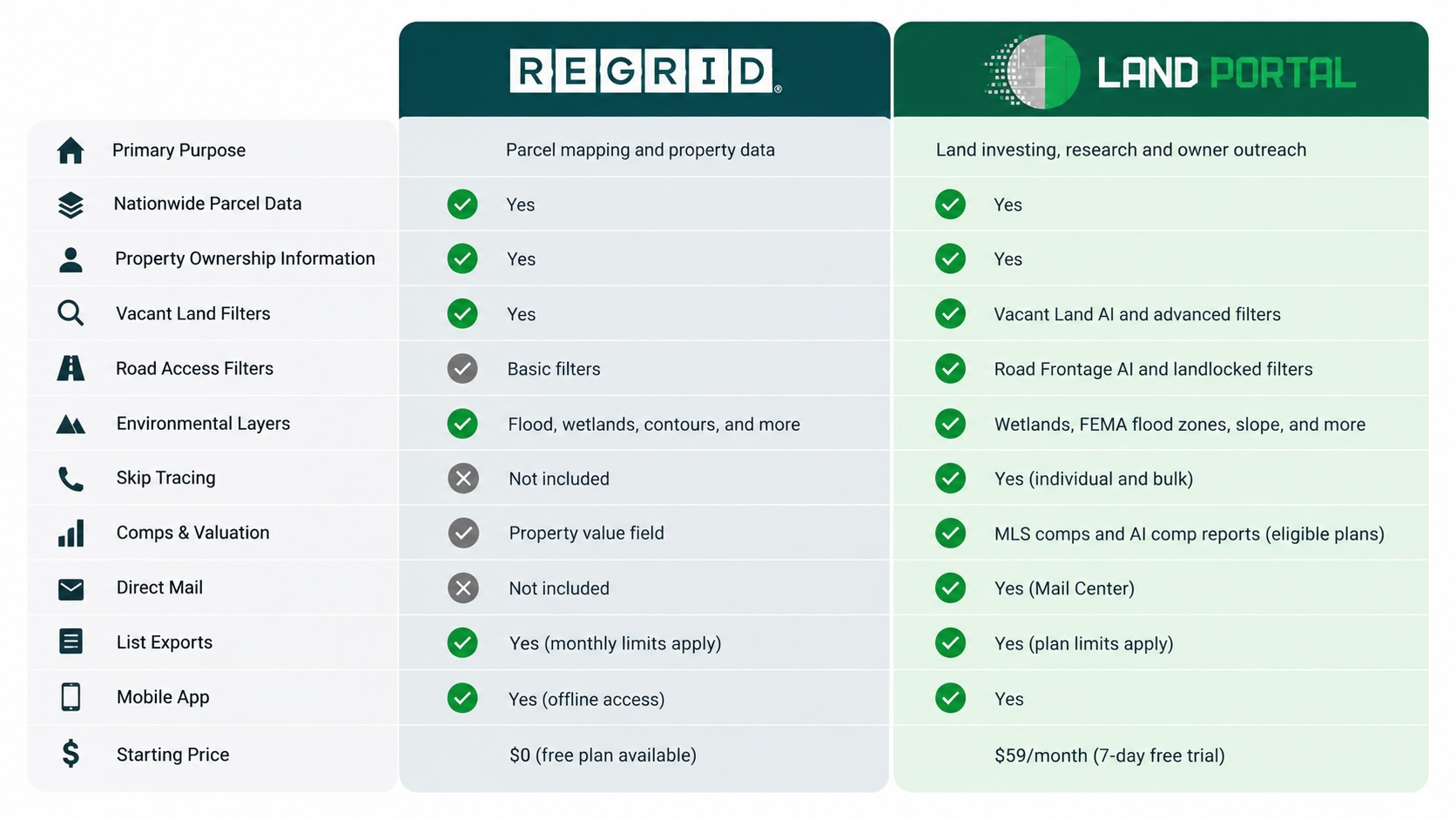
Features and pricing vary by subscription. See Land Portal’s pricing and Regrid’s plans for current details.
The biggest difference isn’t the parcel data itself. It’s what each platform helps you do with that information.
What Is Land Portal Built For?
Land Portal is designed for investors who buy, sell, and research vacant land.
Rather than focusing only on property boundaries and ownership records, the platform brings together the tools investors need to identify potential deals and evaluate them before making an offer.
Finding and Evaluating Vacant Land
Land Portal provides access to nationwide property data alongside filters designed specifically for land investing.
Investors can narrow their searches using criteria such as:
-
Vacant Land AI: Identify properties likely to be vacant.
-
Road Frontage AI and Landlocked filters: Screen for potential road access concerns.
-
Wetlands and FEMA filters: Identify properties affected by mapped environmental conditions.
-
Slope and terrain tools: Evaluate topography and potential buildability.
-
Ownership filters: Target properties based on ownership and location characteristics.
These tools help investors narrow large property searches into more targeted lists. They also help flag potential concerns that deserve additional due diligence.
Market Research and Land Valuation
Land Portal also includes market research tools that help investors compare areas using sold activity, active inventory, days on market, and price per acre.
For individual properties, investors can review comparable land sales and use LP Estimate to generate AI-powered comp reports.
This is particularly useful when determining whether a property is priced appropriately or estimating what it might resell for.
Market Research, nationwide MLS data, and AI comp reports are available on Advanced and higher plans.
Contacting Landowners
Once investors identify properties they’re interested in, Land Portal offers individual and bulk skip tracing to help locate available phone numbers and email addresses.
The platform also includes DNC (Do Not Call) and litigator scrubbing.
For direct mail campaigns, the Land Portal Mail Center supports standard letters and real handwritten mail options.
Best for: Land investors who want to research markets, find properties, evaluate deals, and contact owners using one platform.
What Is Regrid Built For?
Regrid is a property data and mapping platform designed for a broader range of users, including real estate professionals, developers, GIS teams, and property researchers.
Its primary strength is making parcel boundaries and standardized property records accessible through its app, data downloads, and developer services.
Parcel Mapping and Property Research
The Regrid Property App allows users to search properties by address or parcel ID and review information such as ownership, mailing addresses, acreage, and land use.
It also offers filters for vacancy, building count, acreage, and other property characteristics.
Users can explore additional map layers, including:
Flood hazards and wetlands
Elevation contours
Satellite imagery and other basemaps
Building footprints
Regrid also supports property notes, photos, and tracking selected parcels.
Mobile Mapping and Offline Access
One of Regrid’s advantages is its mobile app, which supports offline access for fieldwork and property inspections.
This can be useful for people visiting rural properties or working in areas with limited cellular service.
Parcel Data Exports and APIs
Beyond its mapping app, Regrid offers property data exports, APIs, and bulk parcel datasets.
These services are useful for businesses that want to incorporate property records into their own GIS software, databases, or internal systems.
Regrid does not advertise built-in skip tracing, dedicated MLS land comp reports, or direct mail services as part of its Property App. Investors needing those services may have to use additional tools.
Best for: Users who primarily need parcel boundaries, property records, mobile mapping, or data for external applications.
Land Portal vs. Regrid Pricing
The two platforms have different pricing structures because they serve different needs.
Land Portal Pricing
According to Land Portal’s pricing page, its main monthly plans include:
Starter: Advertised at $59/month, with property research, mapping, basic land filters, and access to skip tracing.
Advanced: Advertised at $99/month, adding nationwide MLS data, market research, advanced filters, and AI comp reports.
Pro: Starting at $199/month, with higher lead allowances and lower skip tracing rates.
Enterprise: Custom options for larger operations and higher-volume data needs.
Land Portal also offers a 7-day free trial on its Starter plan.
Regrid Pricing
Regrid offers a free Starter plan for basic parcel research, with paid Pro and Team options for users who need higher lookup limits and additional capabilities.
Its property data exports, APIs, and bulk datasets have separate pricing considerations depending on the service and volume required.
You can review the options on Regrid’s pricing page.
Which Offers Better Value?
If you only need to look up parcel boundaries or check ownership information occasionally, Regrid’s free plan may be sufficient.
But if you’re actively building landowner lists, researching comparable sales, and running acquisition campaigns, Land Portal includes tools that would otherwise require separate services.
The better value depends on what you’re actually trying to accomplish.
Which Should You Choose: Land Portal or Regrid?
Choose Land Portal if you’re actively investing in land.
It’s designed for finding vacant properties, researching markets, evaluating potential deals, and contacting owners. Its land-specific filters, comping tools, skip tracing, and direct mail capabilities make it a stronger fit for investors managing an acquisition process.
Choose Regrid if your main priority is parcel mapping and property data.
Its free entry point, mobile mapping capabilities, and data services make it a practical option for property lookups, field research, and projects that require parcel records.
Both platforms offer valuable property information. The difference is whether you need a mapping and data tool or software designed around land investing.
If your goal is to find and evaluate more land deals, explore Land Portal’s plans and start your 7-day free trial.
Frequently Asked Questions
Is Land Portal or Regrid better for land investors?
Land Portal is generally the better fit for investors who regularly find vacant land, research comparable sales, and contact property owners. Regrid is well suited to parcel lookups, mapping, and property data access.
How much do Land Portal and Regrid cost?
Land Portal advertises monthly plans starting at $59, with additional features available on Advanced, Pro, and Enterprise plans. Regrid offers a free Starter plan alongside paid subscriptions and separate data services. Check each company’s pricing page for current rates.
Does Regrid include skip tracing or MLS comps?
Regrid’s published Property App features do not list built-in skip tracing or dedicated MLS comp reports. Land Portal offers skip tracing, with nationwide MLS data and AI comp reports available on eligible plans.
Where do Land Portal and Regrid get their parcel data?
Both use public property records as important data sources. Land Portal combines parcel records with MLS information, mapping layers, environmental data, and AI-powered tools. Regrid focuses on collecting and standardizing parcel data from government sources for mapping and analysis.
Is Regrid’s free plan enough for land investing?
It can be enough for basic parcel lookups and occasional property research. Investors who need large targeted lists, comparable sales, skip tracing, or direct mail will likely need additional software.
Your Premium Source For Real Estate Data
© Copyright 2026 Land Portal – All Rights Reserved