


Log in
5 Best Land Valuation Tools for Investors in 2026
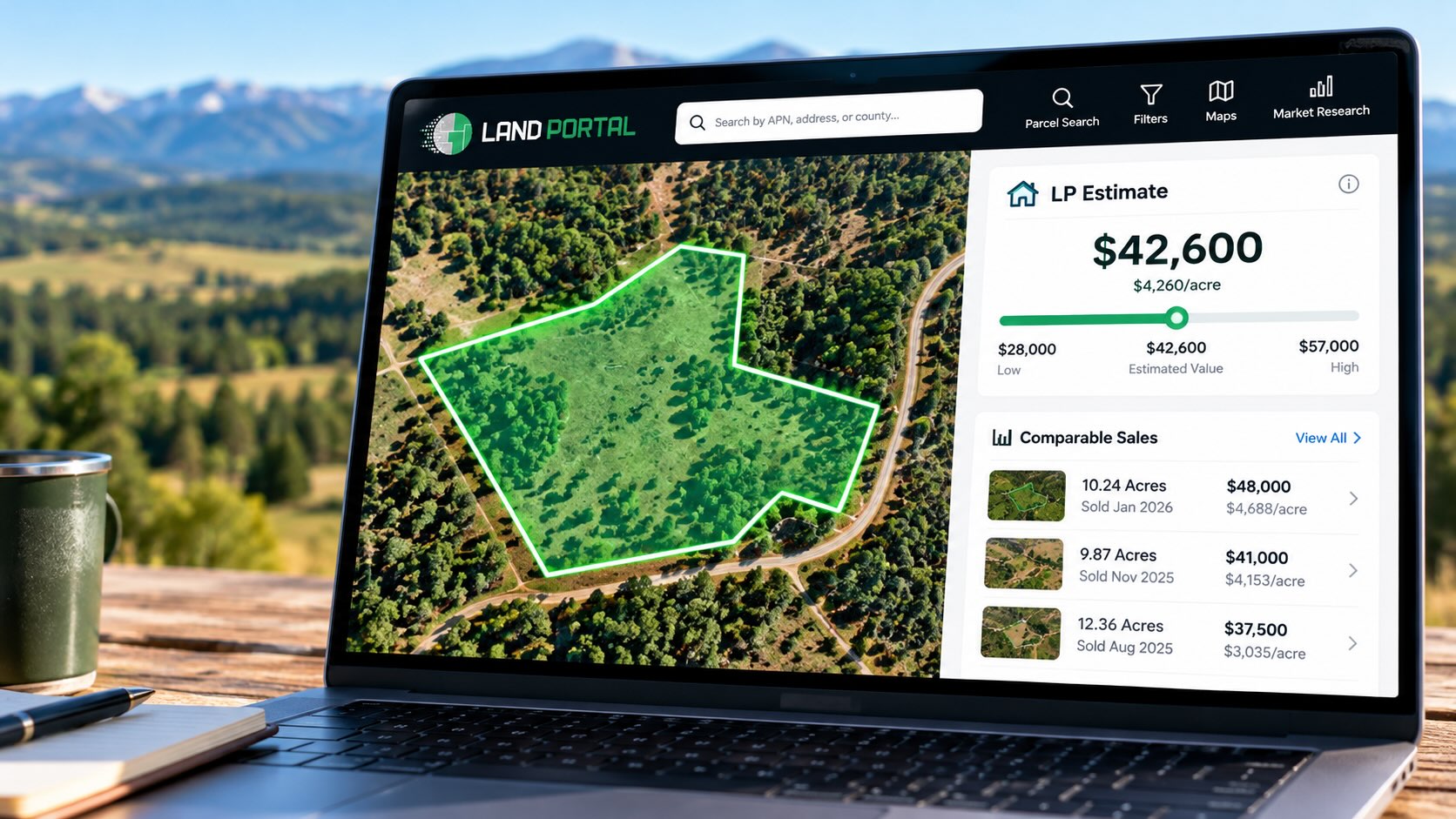
Figuring out what a piece of vacant land is worth isn’t always straightforward.
Unlike residential homes, vacant properties can vary significantly in acreage, access, terrain, zoning, and development potential. Two parcels in the same county might sell for completely different prices.
That’s why land investors rely on comparable sales and property research tools to estimate value before making an offer.
Land valuation software can make that process much faster, but not every platform calculates or presents property values the same way.
Some focus on recent land sales. Others use automated estimates, agricultural data, or a combination of AI and manual research.
Here are five land valuation tools worth considering in 2026, what each does best, and how to determine whether an estimate is reliable.
Best Land Valuation Tools: Quick Comparison
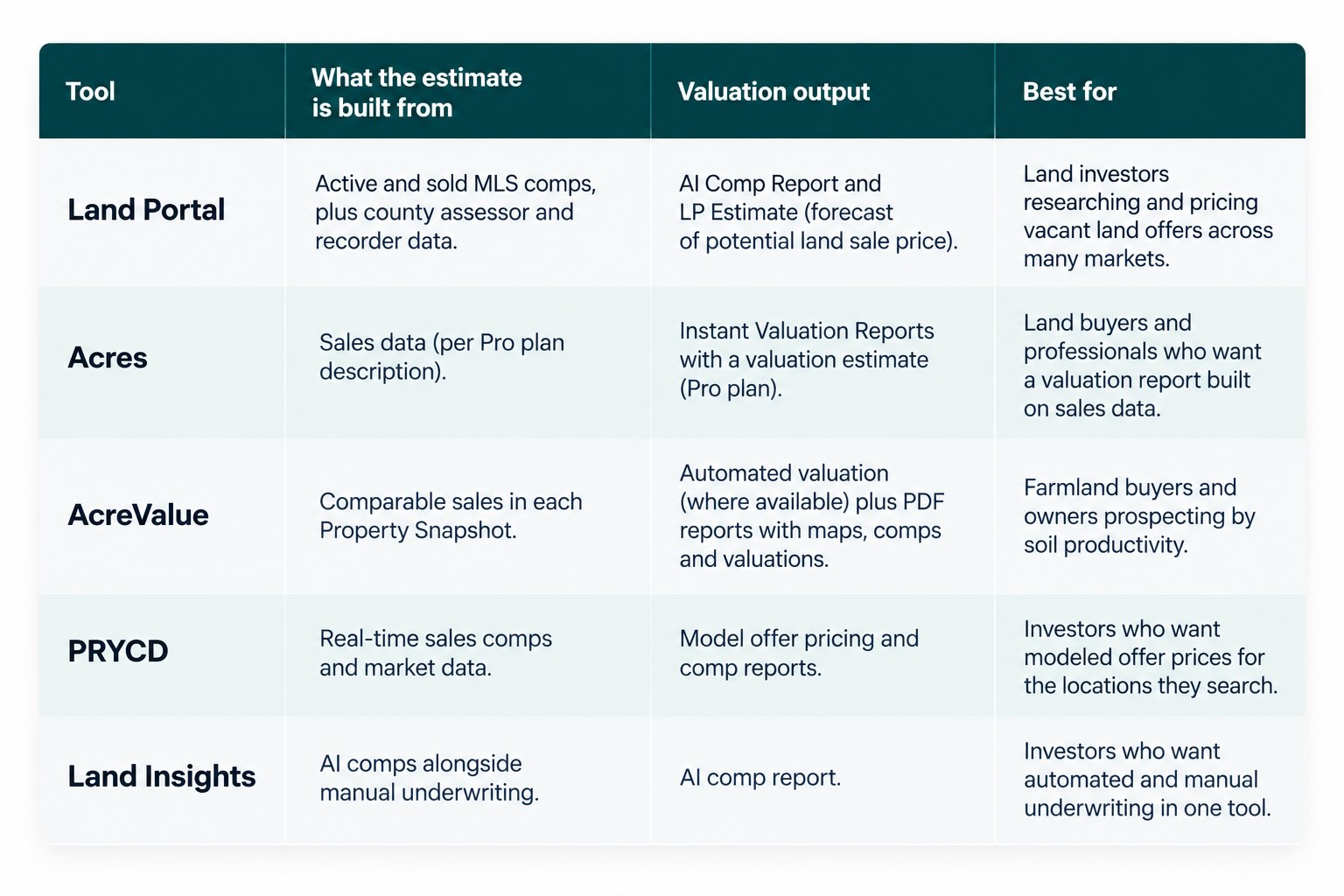
Each platform approaches land valuation differently. The right choice depends on the properties you invest in and how you prefer to evaluate deals.
1. Land Portal: Best for Vacant Land Investors
Land Portal is built specifically for land investors, combining nationwide property data, comparable sales, market research, and land-specific due diligence tools.
Its LP Estimate provides an AI-powered property value estimate alongside a comp report that helps investors review comparable properties.
Rather than relying on an estimate alone, investors can examine relevant sales and adjust their research based on the property’s characteristics.
Key features include:
Nationwide MLS data: Research active and sold land listings.
AI Comp Reports: Review comparable properties and estimated values.
LP Estimate: Generate an AI-powered starting point for property valuation.
Market Research: Compare inventory, sold activity, days on market, and price per acre.
Land-specific filters: Evaluate road frontage, landlocked properties, wetlands, FEMA flood zones, and slope.
These features are particularly useful when evaluating vacant land across multiple counties or building acquisition lists.
Land Portal also combines valuation with owner research, skip tracing, and direct mail capabilities, allowing investors to move from property research to outreach.
Best for: Land investors who want comparable sales, property valuation, and land research tools in one platform.
Pricing: Land Portal’s Advanced plan includes AI Comp Reports, nationwide MLS data, and Market Research. See current plans and pricing.
2. Acres: Best for Sales-Based Valuation Reports
Acres is a land mapping and property data platform that provides tools for researching parcels, ownership, and land characteristics.
Its Pro plan includes Instant Valuation Reports that generate property estimates using sales data.
The platform also provides information such as acreage, land use, ownership, and assessment details to support property research.
For investors and land professionals who want a valuation report alongside detailed parcel information, Acres is worth considering.
Best for: Land buyers, brokers, and professionals who want sales-based valuation reports and property mapping.
Pricing: Instant Valuation Reports are included in eligible paid plans. See Acres pricing.
3. AcreValue: Best for Farmland Valuation
AcreValue focuses heavily on agricultural land, making it particularly useful for farmland investors and property owners.
In addition to comparable sales and property value estimates, the platform provides soil productivity information and agricultural mapping tools.
Its Property Snapshot feature can include:
Comparable property sales
Automated valuations where available
Parcel maps and property information
Shareable property reports
For agricultural properties, soil productivity can be an important factor in valuation. AcreValue makes it easier to research that information alongside sales data.
However, investors focused primarily on recreational lots, residential vacant land, or smaller infill parcels may have different research needs.
Best for: Farmland buyers, agricultural landowners, and investors evaluating land productivity alongside market value.
Pricing: AcreValue offers free and paid options, with valuation and sales data access varying by plan. See AcreValue pricing.
4. PRYCD: Best for Calculating Land Offer Prices
PRYCD focuses on helping real estate investors research markets and determine potential offer prices.
Its valuation tools use comparable sales and market information to generate modeled pricing suggestions.
The platform includes features such as:
Location-based market analysis
Modeled offer pricing
Comparable sales research
Property comp reports
This approach can be useful for investors who want to establish pricing targets before building acquisition lists or contacting property owners.
As with any automated pricing model, investors should still review the comparable sales and consider the individual property’s characteristics before making an offer.
Best for: Investors who want modeled offer prices and comp reports for their target markets.
Pricing: PRYCD offers multiple subscription options, with comp report allowances and additional charges depending on the plan. See PRYCD pricing.
5. Land Insights: Best for AI and Manual Underwriting
Land Insights combines automated property valuation with tools for manually evaluating potential land deals.
Its AI comp reports help investors generate estimated values, while manual underwriting features allow them to conduct their own analysis.
This can appeal to investors who prefer to compare automated results against their own assumptions and property research.
Land Insights also offers property data services and subscription options for investors managing ongoing acquisition activity.
Best for: Investors who want AI-powered comparable sales alongside manual underwriting tools.
Pricing: Land Insights offers subscription and property data options. See its website for current pricing.
How Accurate Are Automated Land Valuation Tools?
An automated land estimate is only as useful as the data and comparable sales behind it.
Unlike homes in established neighborhoods, vacant land can be difficult to value because properties often have fewer directly comparable sales.
For example, two 10-acre parcels might be located only a few miles apart, but one has paved road access and level terrain while the other is landlocked and heavily sloped.
Even if their acreage is identical, their market values could be very different.
That doesn’t mean automated estimates aren’t useful. It means investors need to understand what goes into the number.
1. Recent Sold Comps Matter Most
Active listings can help you understand what sellers are asking, but they don’t necessarily reflect what buyers are willing to pay.
Recent sold properties generally provide a stronger starting point for estimating market value.
When reviewing a valuation, look for comparable sales with similar acreage, location, and property characteristics.
2. Property Characteristics Can Change the Value
A reliable valuation should account for more than acreage.
Road access, wetlands, flood zones, slope, zoning, and nearby development can all influence what buyers are willing to pay.
This is why mapping and due diligence tools are valuable alongside comparable sales.
3. Older Sales May Not Reflect Today’s Market
Land prices can change as inventory, buyer demand, and local market conditions shift.
For example, the Federal Reserve Bank of Kansas City reported changes in agricultural land values during 2026.
While agricultural trends don’t necessarily represent every vacant land market, they illustrate why investors should pay attention to when comparable properties sold.
4. Automated Estimates Have Limitations
Not every property has enough comparable sales to support a strong automated estimate.
Even widely used residential valuation tools have limitations. Zillow’s Zestimate, for example, is designed for residential properties rather than vacant land.
For land investors, the important question isn’t whether a tool produces a number. It’s whether the underlying data supports that estimate.
5. A Valuation Estimate Isn’t a Formal Appraisal
Land valuation software is useful for researching deals and estimating potential purchase or resale prices.
However, certain transactions require a qualified appraisal rather than an automated estimate.
For example, the IRS instructions for Form 8283 explain appraisal requirements that apply to certain noncash charitable contributions.
For ordinary land investing decisions, software can provide a valuable starting point, but it shouldn’t replace necessary due diligence or professional valuations.
How to Choose the Right Land Valuation Tool
Before subscribing to a platform, test it using a property or market you already know.
Start by generating an estimate, then review the supporting information.
Ask yourself:
Can I see the comparable sales? A valuation is more useful when you can review the properties behind it.
Are the comps actually comparable? Check acreage, location, access, terrain, and other important characteristics.
How recent are the sales? Older transactions may not reflect current market conditions.
Can I evaluate the property itself? Mapping, road access, wetlands, and slope tools can help explain differences in value.
Does the pricing make sense? Consider subscription costs, report limits, and any additional charges.
The best tool is one that helps you understand why a property might be worth a certain amount, not just one that produces an estimate quickly.
Which Land Valuation Tool Should You Choose?
Each of these platforms has strengths depending on the type of land you’re researching.
Land Portal is a strong fit for vacant land investors who want nationwide comps, AI-powered estimates, market research, and due diligence tools together.
Acres is worth considering for sales-based valuation reports and parcel research.
AcreValue is particularly useful for farmland and agricultural property analysis.
PRYCD focuses on modeled offer pricing and comparable sales for investors researching target markets.
Land Insights offers a combination of AI comps and manual underwriting.
For most active vacant land investors, having access to comparable sales and land-specific property research in the same platform can make the valuation process significantly easier.
If you’re evaluating vacant land deals, explore Land Portal’s plans and start your 7-day free trial to see how its comping and market research tools fit your investing strategy.
Frequently Asked Questions
What is the best land valuation tool in 2026?
It depends on the type of property you’re researching. Land Portal is a strong option for vacant land investors who want nationwide MLS comps, AI estimates, and land-specific research tools.
Acres offers sales-based valuation reports, AcreValue focuses on farmland, PRYCD provides modeled offer pricing, and Land Insights combines AI comps with manual underwriting.
How much do land valuation tools cost?
Pricing varies by platform and subscription level. Some offer limited free access, while others charge monthly or annual subscriptions. Valuation reports may be included, limited by usage, or charged separately. Review each provider’s pricing page to compare total costs.
How do land valuation tools estimate property values?
Most use comparable sales, market information, and property characteristics to estimate value. Some also incorporate automated models, soil productivity, or other data. The reliability of an estimate depends heavily on the quality and relevance of its supporting information.
How accurate are automated land valuations?
Accuracy varies by property, market, and available comparable sales. There’s no single accuracy percentage that applies to every land valuation platform.
Automated estimates are best used as starting points that investors verify against recent sold comps and property-specific conditions.
Do I need a different land valuation tool for every state?
Not necessarily. Some platforms provide nationwide property data and comparable sales, while others offer certain features or datasets on a state-by-state basis.
Before subscribing, confirm that the platform covers the counties and property types you plan to research.
Your Premium Source For Real Estate Data
© Copyright 2026 Land Portal – All Rights Reserved