DataTree has long been a popular source of property, ownership, and recorded-document data. Its depth makes it valuable for title research, ownership verification, and document-based due diligence.
The challenge is that DataTree was not built specifically for land investors. Its tools are designed around property records and title research rather than the full process of finding, evaluating, and marketing vacant land.
That difference becomes noticeable when you need land-specific filters, mapping layers, comparable land sales, owner outreach, and mailing tools in the same platform.
This article compares DataTree with Land Portal and explains which platform is better suited for each part of the land investing process.
The Core Difference: Title Research vs. Land Investing
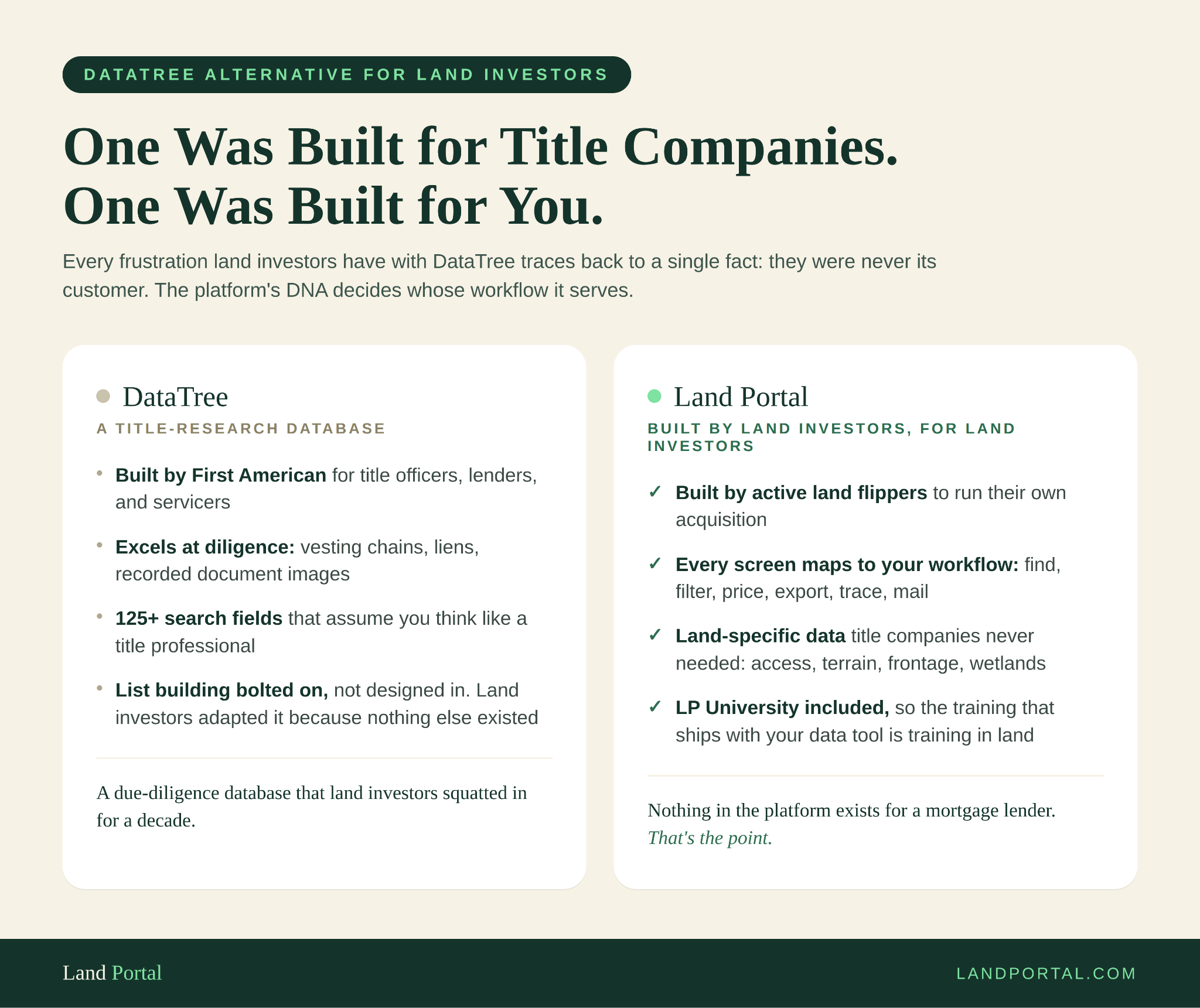
DataTree is a First American platform built primarily for title professionals, lenders, appraisers, and other users who need detailed property and recorded-document data.
That is where it performs best. It provides access to ownership records, deed images, transaction history, liens, and other information used during title research and due diligence.
Land investors can use that data to build lists, but the platform was not designed around the way a land acquisition business operates. Land-specific property screening, market research, mapping, comps, skip tracing, and direct mail often require additional tools.
Land Portal was built specifically for land investors. Its workflow is organized around finding markets, identifying properties, screening out poor-fit parcels, reviewing comps, locating owners, and preparing for outreach.
The difference is not that one platform has data and the other does not. It is that they were built for different types of work.
Land-Specific Filters and Property Screening
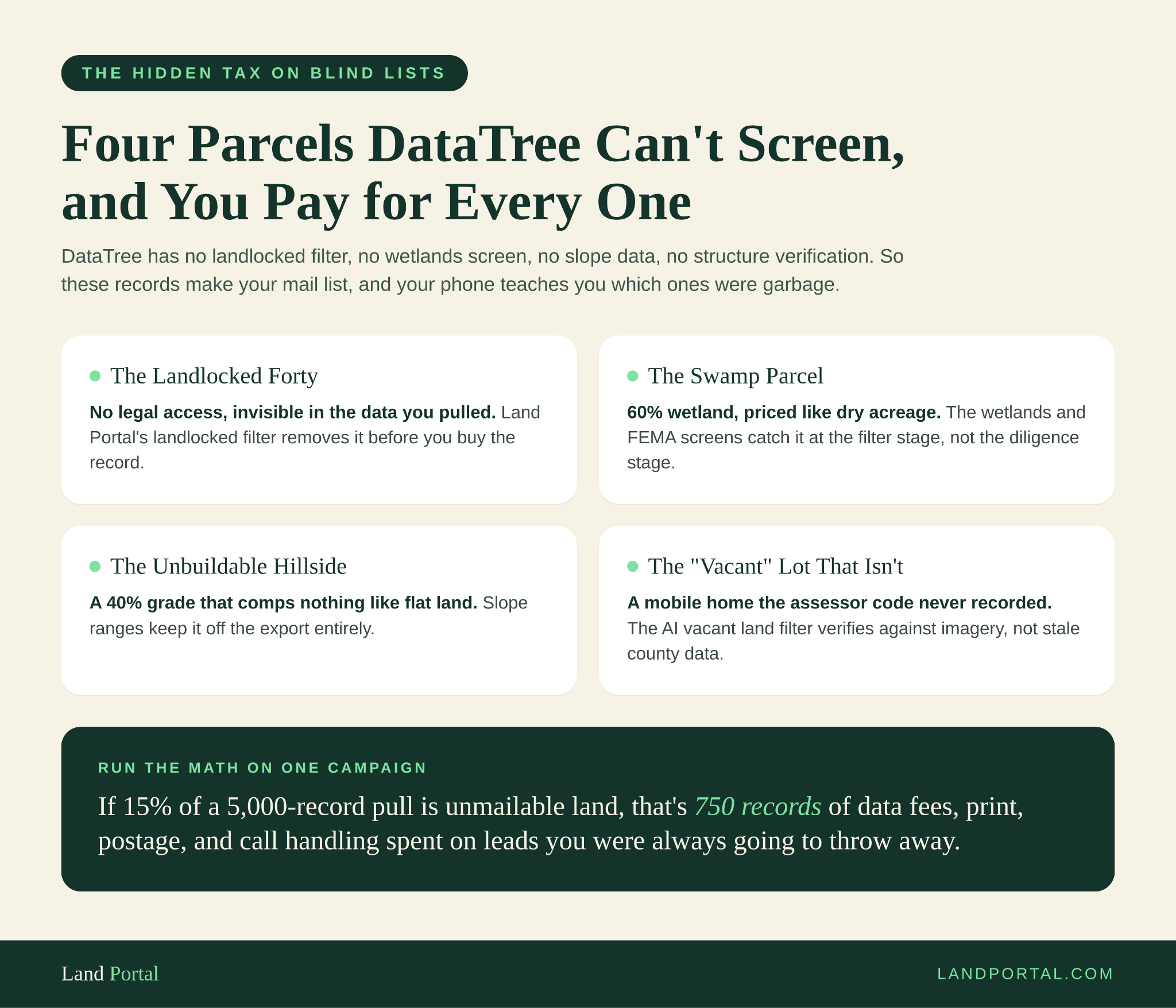
DataTree allows investors to search by common property and ownership criteria, but it does not provide the same level of land-specific screening as a platform built for vacant land.
That matters because parcels that appear similar in a property database can have very different investment potential. A parcel may be landlocked, covered by wetlands, located in a flood zone, too steep to build on, or incorrectly classified as vacant.
When those conditions are not identified until after the list is purchased or the owner is contacted, investors spend money marketing properties they may never want to buy.
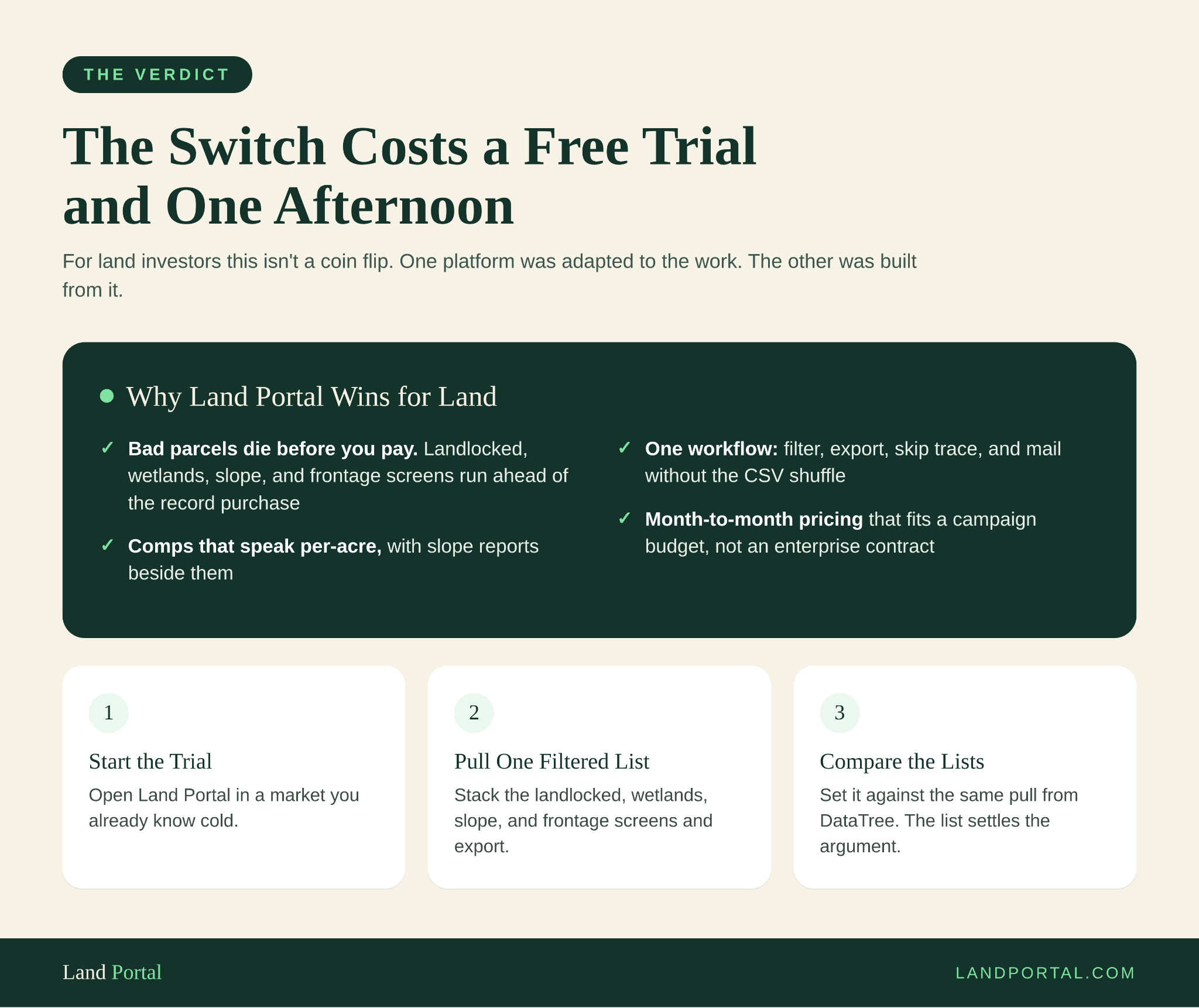
Land Portal includes land-specific tools designed to screen for those issues earlier. These include AI Vacant Land filtering, landlocked filtering, Road Frontage AI, wetlands and FEMA data, slope analysis, and buildability tools.
Applying those filters before exporting or marketing a list helps investors focus their budget on properties that better match their investment strategy.
The larger the campaign, the more expensive poor targeting becomes. Even a small percentage of landlocked, flood-prone, heavily sloped, or incorrectly classified parcels can lead to unnecessary data fees, skip tracing costs, printing, postage, and follow-up.
Land Portal’s filtering tools help reduce that waste by identifying more of those issues before the property enters your mailing list.
Pricing and Contract Flexibility
DataTree generally uses subscription plans, credit allotments, and additional charges for certain records or reports. Contract terms and pricing may vary, so investors should review the current agreement carefully before committing.
Land Portal offers multiple subscription options for solo investors, growing teams, and higher-volume operations. Its pricing structure is designed around the research, data, and marketing needs of land investors.
The more important comparison is not simply the price of each record. It is the cost of each usable property on the final list.
Land-specific filters can help reduce the number of records purchased, skip traced, or mailed when the underlying properties do not match the investor’s criteria.
Because plans and pricing can change, compare the current terms of both platforms directly before making a decision.
Land Comps and Property Valuation
DataTree provides sales history and property valuation data, but it was not designed specifically around the challenges of valuing vacant land.
Land comps require more than matching nearby sales. Acreage, access, road frontage, terrain, wetlands, utilities, and buildability can all affect value.
Land Portal combines nationwide MLS data, sold land comps, AI-powered property values, mapping, and land-specific property characteristics in one place.
This makes it easier to review comparable sales alongside the physical conditions that may explain why two similarly sized parcels sold for very different prices.
For subdivision and development opportunities, frontage, slope, and buildability information can also be reviewed alongside the comps.
Property Research and Outreach in One Platform
DataTree is strongest as a property and title data source. Investors commonly export that data and use separate platforms for mapping, skip tracing, direct mail, comps, and campaign management.
Land Portal brings more of that process together. Investors can research markets, filter properties, review mapping layers, analyze comps, access owner information, run skip traces, export lists, and send direct mail from the same platform.
Mobile access also makes it possible to review parcel boundaries, terrain, Street View, measurements, and reports while working away from a desktop.
Every account includes Land Portal University, with step-by-step training on market research, property evaluation, list building, and using the platform more effectively.
Keeping the core acquisition workflow connected can reduce manual exports and make the overall process easier to manage.
Where DataTree Still Makes Sense
DataTree remains a strong option for detailed ownership and document research.
Recorded deed images, transfer history, vesting information, liens, and other title-related records can be valuable when verifying ownership or performing deeper due diligence.
Investors who regularly need that level of document access may still find DataTree useful, either as their primary research source or as a specialized tool used alongside another land investing platform.
The decision depends on whether the business needs detailed title data or a broader platform for sourcing, evaluating, and marketing vacant land.
The Verdict
DataTree and Land Portal serve different purposes.
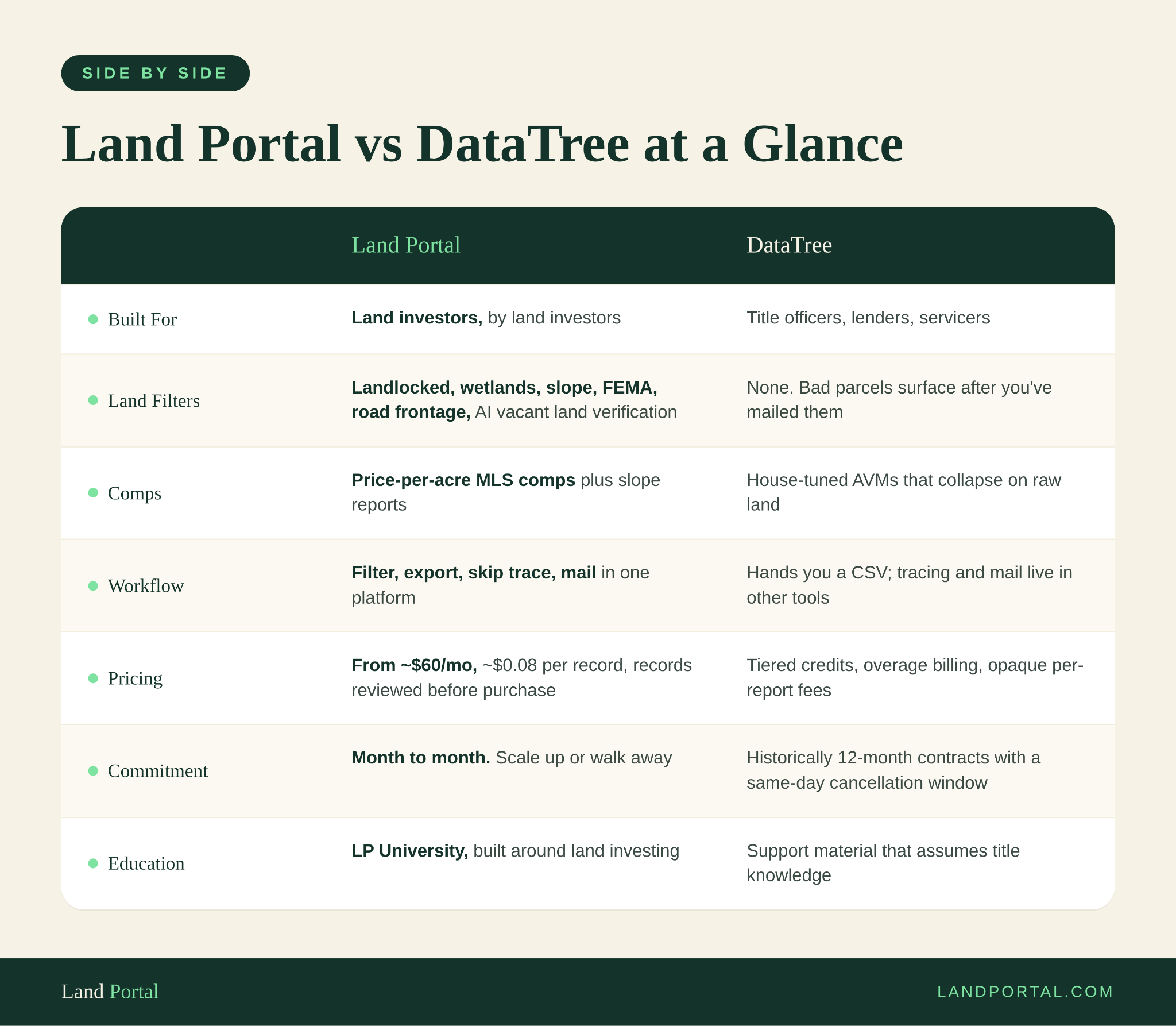
DataTree is strongest for detailed property, ownership, deed, and title research. Land Portal is built for the broader land investing workflow, including market research, land-specific filtering, mapping, comps, owner data, skip tracing, direct mail, exports, and education.
Investors who primarily need recorded documents and title research may prefer DataTree. Those who want to find, evaluate, and market vacant land from one connected platform will likely find Land Portal to be the better fit.
The best way to compare them is to test both against a market you already understand. Build the same list, review the property quality, compare the research process, and determine which platform better supports the way your business actually operates.
The best way to compare the two platforms is to test them using a market you already know. Build the same list in each one, review the quality of the properties returned, and compare how much time and manual work it takes to get from research to outreach.
The differences become much easier to see when you’re evaluating real properties instead of comparing feature lists.
Land Portal combines market research, land-specific property filters, mapping, MLS comps, owner data, skip tracing, direct mail, and exports in one platform built specifically for land investors.
Every account also includes Land Portal University, with step-by-step training to help you research markets, evaluate properties, and build better lists.