Choosing the right land investing software can have a major impact on how efficiently you research markets, evaluate properties, build mailing lists, and manage deals.
The challenge is that many platforms marketed to land investors were originally built for residential real estate and only later added vacant land features.
Before comparing feature lists or pricing, it’s important to understand whether a platform was designed around the way land investors actually work.
This guide walks through the key factors to evaluate before choosing land investing software.
Make Sure the Platform Is Built for Land Investing
Many real estate platforms now include vacant land filters, but that doesn’t necessarily mean they were designed for land investing.
One of the quickest ways to evaluate a platform is to test how it handles the unique challenges of valuing and researching vacant land.
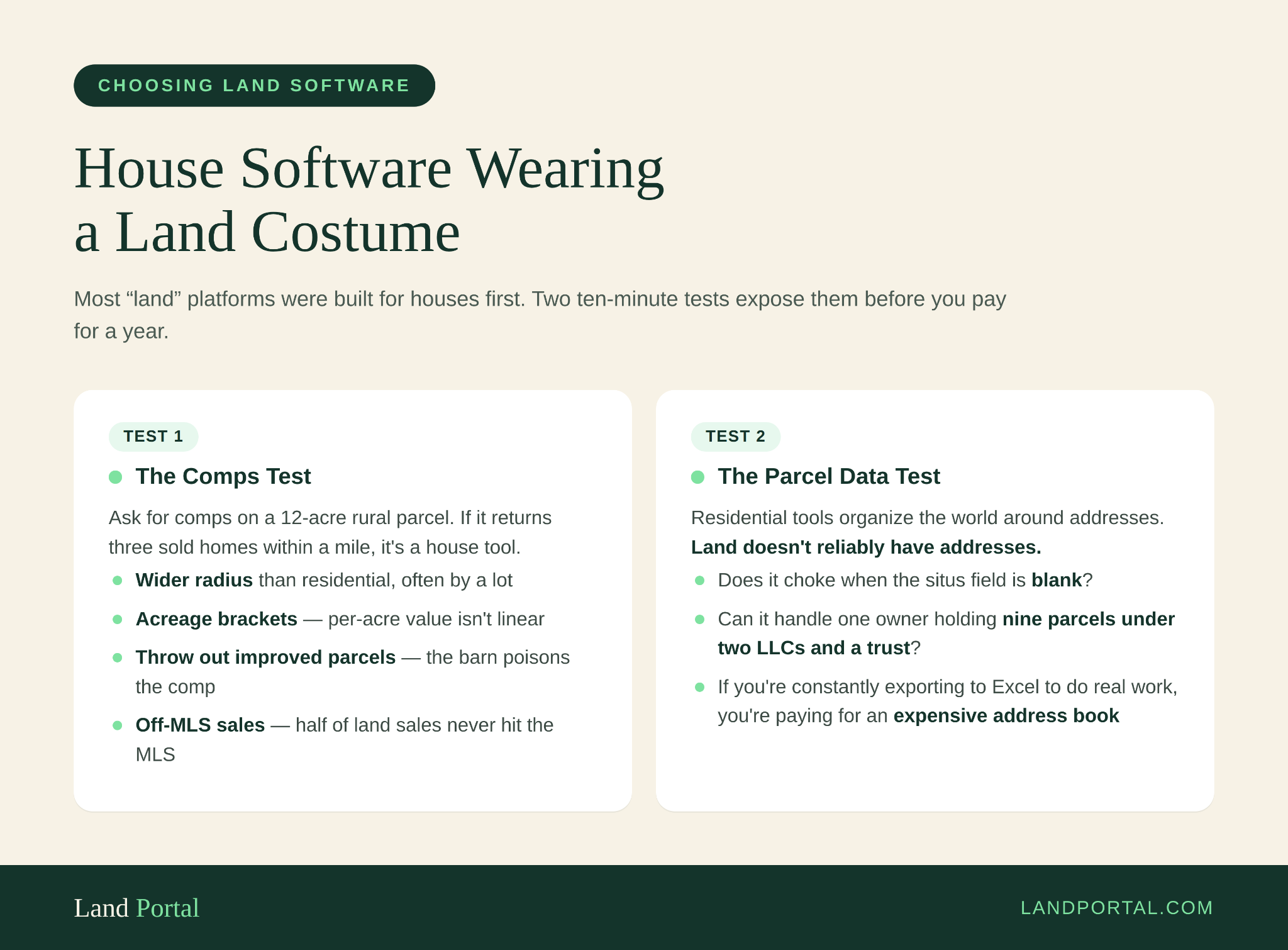
The comps test
Ask the platform to generate comparable sales for a rural vacant parcel you already know well.
A land-focused platform should evaluate comparable sales differently than residential software by considering factors such as acreage, road access, improvements, and the availability of nearby land sales.
If the platform primarily returns residential home sales or struggles to identify relevant vacant land transactions, it may not be designed specifically for land investing.
The parcel data test
Vacant land often has limited addressing information, so software should organize property records around parcel data rather than street addresses.
It should also make it easy to work with multiple parcels owned by the same individual or entity without requiring extensive spreadsheet cleanup or manual organization.
Database Size Isn't Everything
Most major platforms provide nationwide parcel coverage, but the size of the database is only part of the picture.
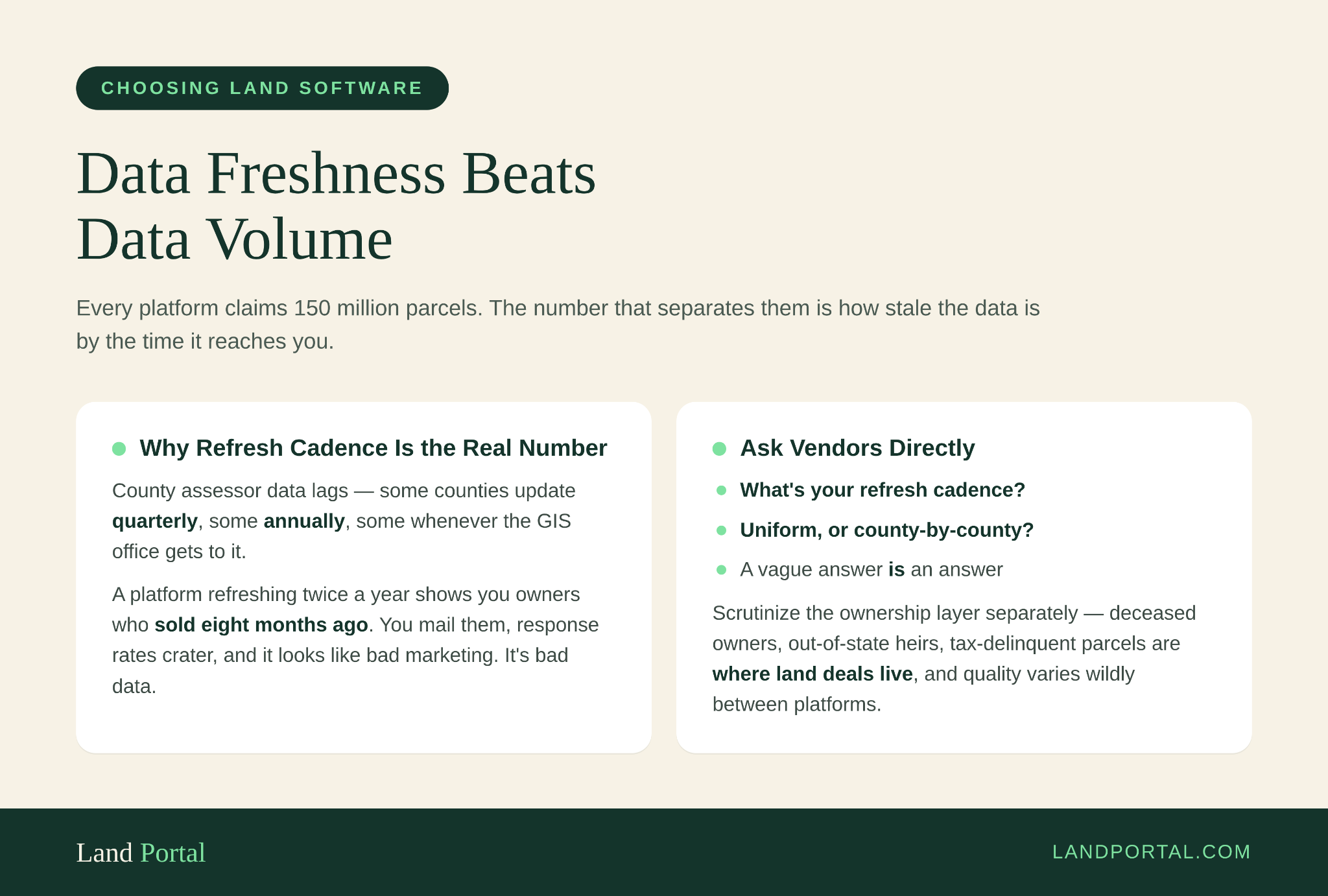
Equally important is how frequently ownership and property data are updated.
Why Updated Property Data Matters
County records update at different schedules, so every platform must regularly refresh its ownership and property data.
Ask providers how often records are updated, whether updates occur nationwide or county by county, and how quickly ownership changes become available.
More current data generally leads to better mailing accuracy and fewer outdated owner records.
Look Closely at the Owner Information
Ownership data is especially important for land investors.
Features such as absentee ownership, long-term ownership, inherited property, tax delinquency, and portfolio ownership can make it easier to identify motivated sellers, but the quality and availability of those filters varies by platform.
Match the Software to the Business You Actually Run
Before comparing feature lists, think about how you actually invest today rather than the business you hope to build someday.
The right platform depends on your acquisition strategy, deal volume, and day-to-day workflow.
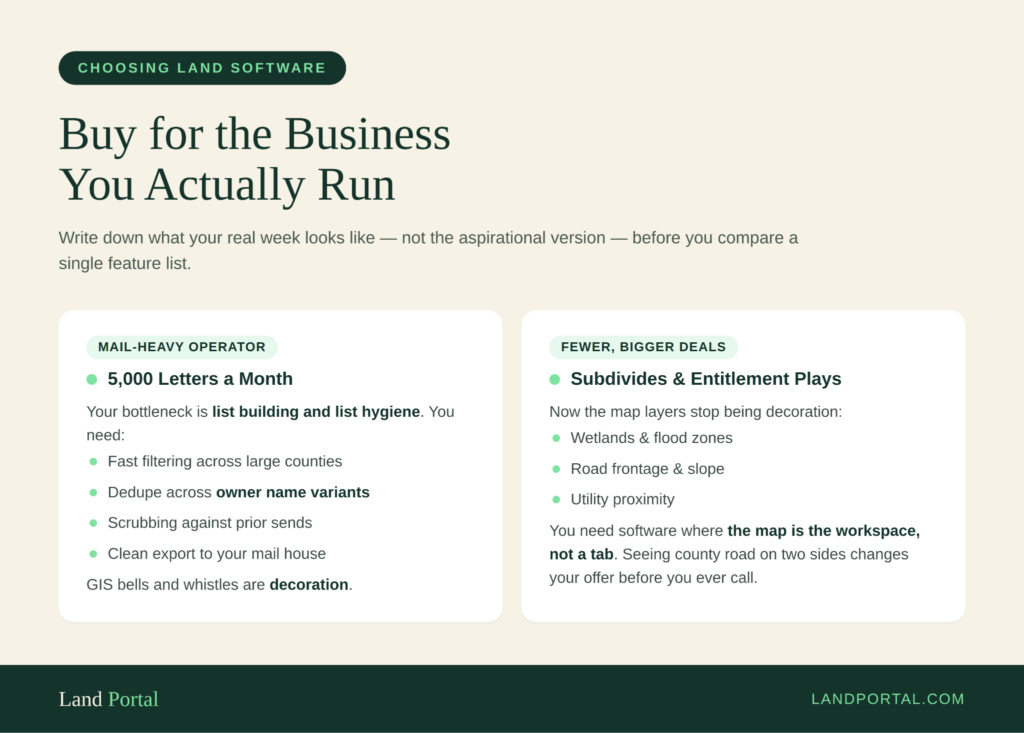
If you're a mail-heavy operator
Sending 5,000 letters a month means your bottleneck is list building and list hygiene. What you need:
• Fast filtering across large counties
• Dedupe that works across owner name variants
• Scrubbing against your prior sends
• Clean export to your mail house
Prioritize efficient list building, owner data, and export tools over advanced mapping features you may rarely use.
If you're doing fewer, bigger deals
Investors focused on larger acquisitions, subdivisions, or development opportunities often benefit from detailed mapping layers such as wetlands, flood zones, road frontage, slope, utility proximity, and terrain analysis.
These tools make it easier to evaluate a property’s development potential before contacting the owner.
Choose software that supports the business you’re running today. As your investment strategy evolves, your software needs may evolve as well.
Decide Whether Skip Tracing and Direct Mail Should Be Integrated
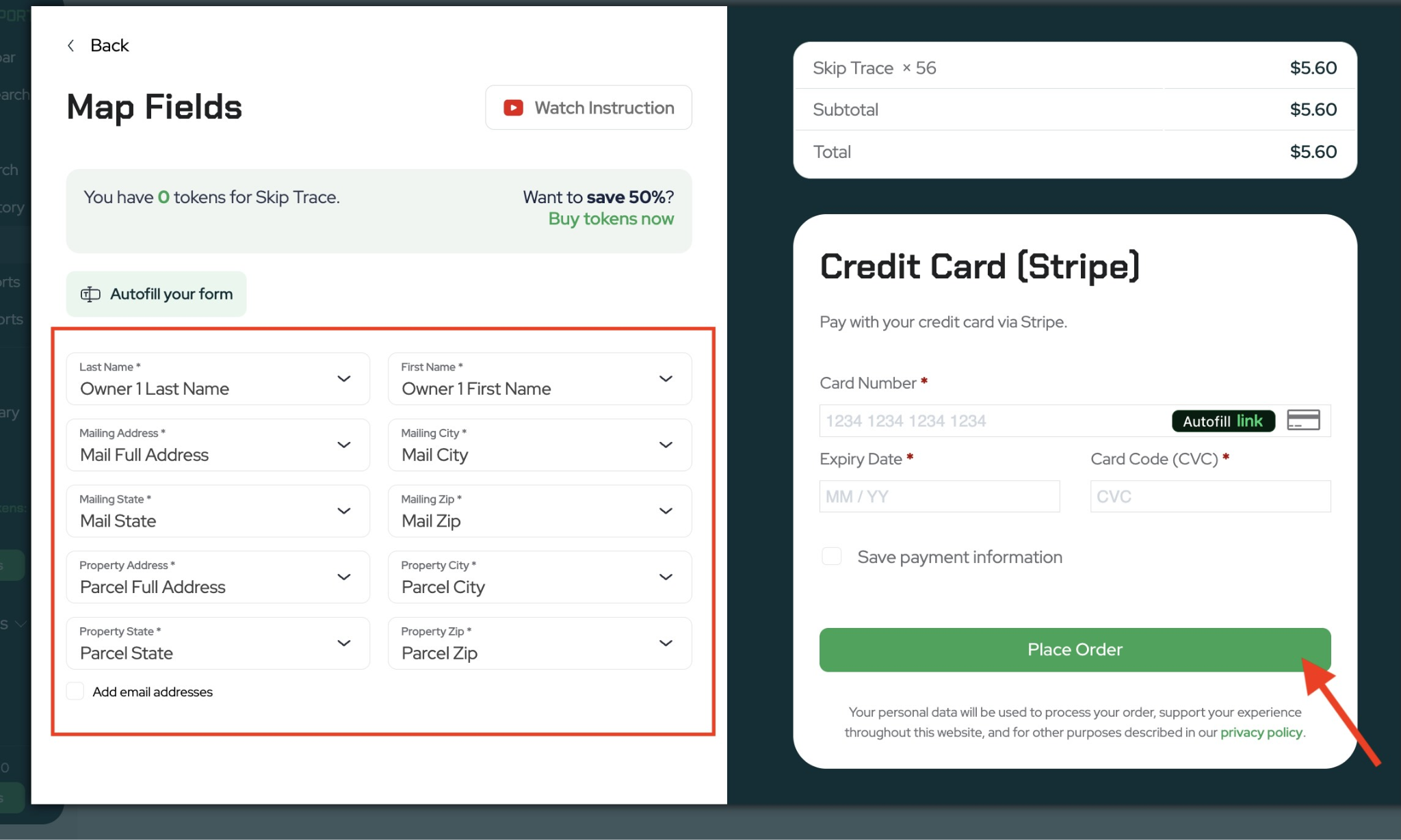
Many land investing platforms now include integrated skip tracing and direct mail, while others allow investors to export lists and use third-party providers.
Integrated tools can simplify workflow and reduce the number of platforms you manage.
Investors who require more control over pricing, vendors, or outreach strategies may still prefer using specialized third-party services.
The best option depends on how your business operates.
If your entire acquisition engine runs on reaching owners, it may be worth keeping skip tracing separate so you can switch providers when hit rates drop, and they do drop, provider by provider, over time.
Evaluate the Pricing Structure
Subscription price is only one part of the decision.
Consider how pricing aligns with the way you invest. Some platforms charge by user, some by market, some by usage, and others include different features at different subscription levels.
Also review whether you can export your data if you cancel your subscription. Maintaining access to your property research and notes is an important consideration when choosing long-term software.
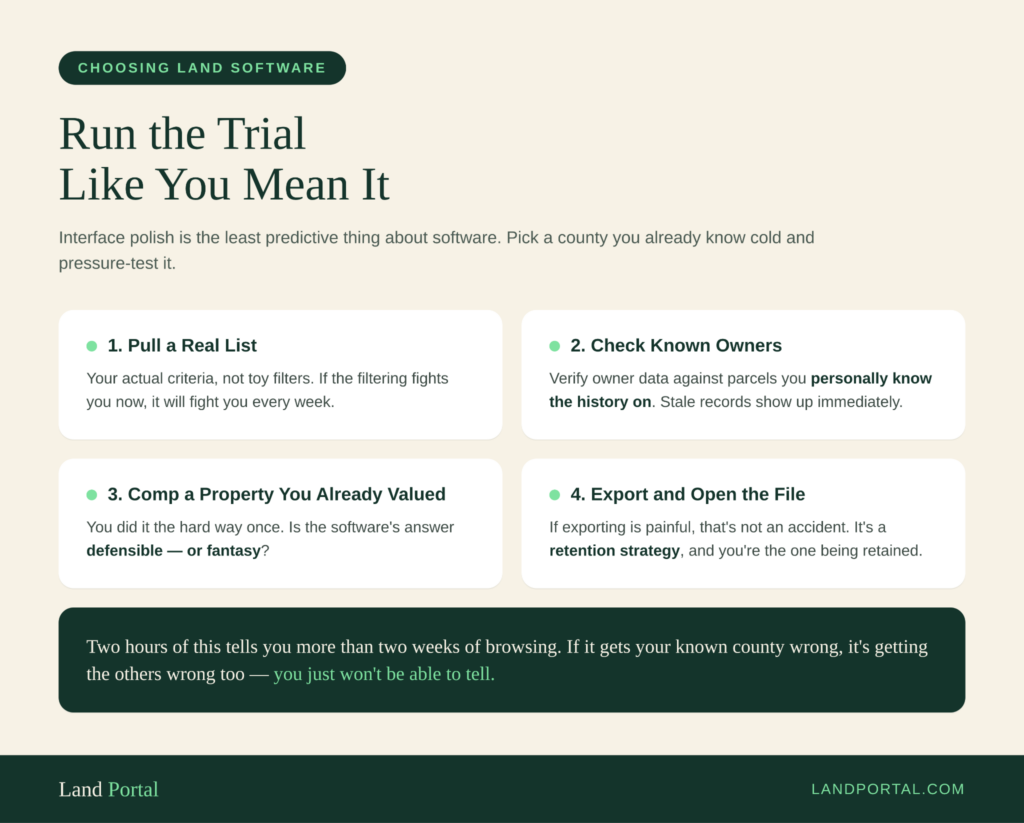
Run the Trial Like You Mean It
A free trial is one of the best opportunities to evaluate whether software fits your workflow.
Rather than simply exploring the interface, use the trial to complete the same research tasks you perform during a normal acquisition campaign.
Instead, pick a county you already know, one where you’ve done deals or at least serious diligence, and pressure-test:
• Pull a list with your real criteria, not toy filters
• Check owner data against parcels you personally know the history on
• Run comps on a property you already valued the hard way and see if the answer is defensible or fantasy
• Export something and open the file
Two hours of that tells you more than two weeks of browsing. If the platform gets your known county wrong, it’s getting the counties you don’t know wrong too. You just won’t be able to tell.
Remember What Software Is Meant to Do
Good software helps you research markets, identify promising properties, organize owner data, and manage your acquisition process more efficiently.
It does not replace market knowledge, consistent marketing, or sound investment decisions.
The best platform is the one that removes friction from your workflow so you can spend more time evaluating properties and talking with motivated sellers.
Before committing to a platform, test it using a market you already understand. Evaluate the quality of the data, the property research tools, the owner information, and the overall workflow.
Choosing software that aligns with your investing strategy will save time, improve decision-making, and make it easier to scale your business over time.