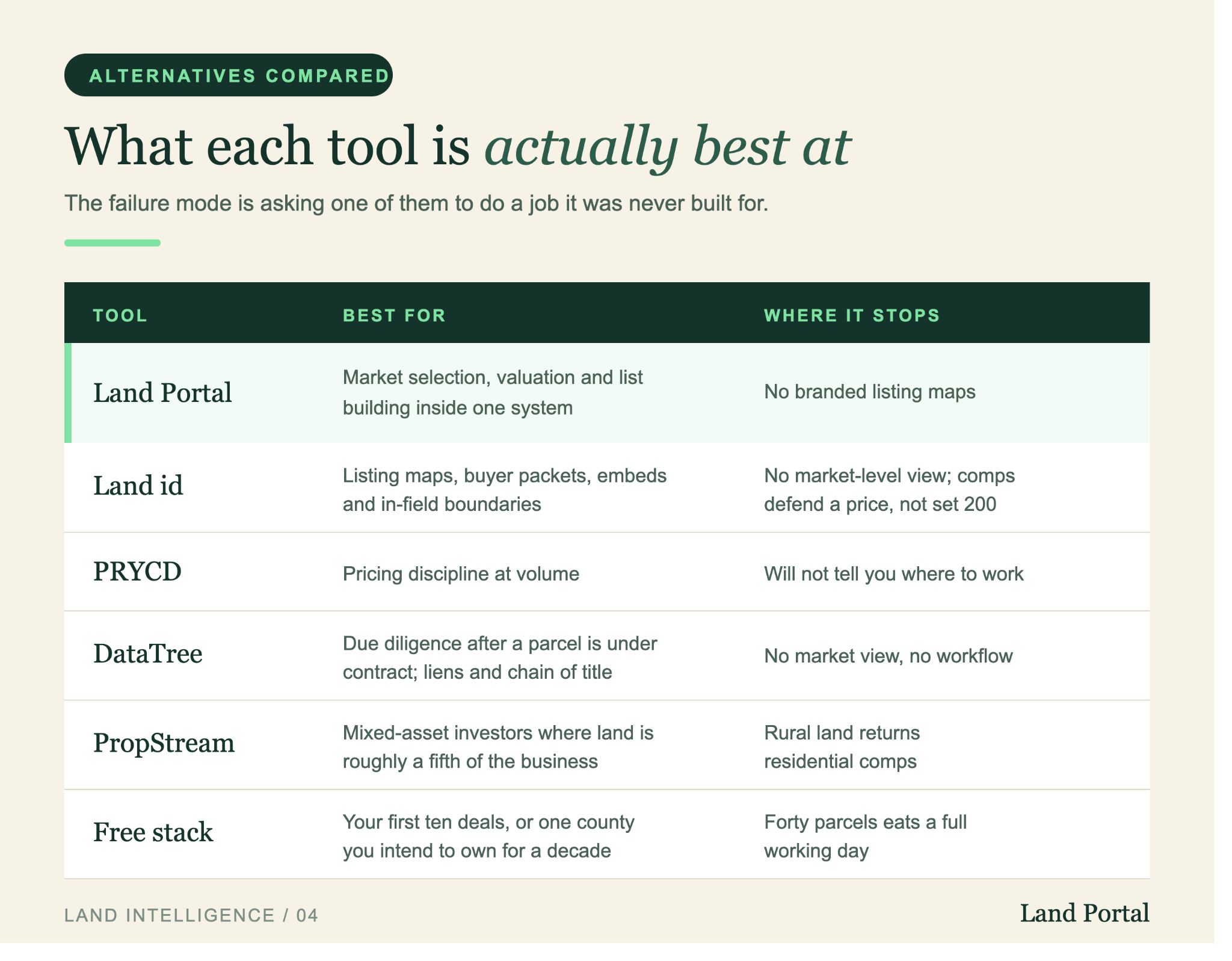
Land ID is a strong mapping platform for land professionals. It gives users access to parcel boundaries, property data, topography, flood information, soil data, and other mapping tools that are useful for researching and presenting individual properties.
But mapping is only one part of a land investing workflow.
Investors also need to decide which markets to target, find properties that match their buy box, research owners, evaluate comparable sales, price potential deals, and build mailing lists.
Depending on which part of that process you’re trying to improve, another platform may be a better fit, or may work alongside Land ID rather than replacing it.
Below, we’ll compare several Land ID alternatives based specifically on how they fit into a land investing business.
Why Land Investors Look for Land ID Alternatives
Land ID can be a good fit when mapping and property presentation are the priority. The gap for some land investors is that their workflow starts before they have a specific parcel to map.
They may also need to:
• Research and compare markets before choosing a county
• Build targeted lists using land-specific property characteristics
• Find and evaluate comparable land sales
• Research property owners and portfolios
• Skip trace owners and prepare mailing lists
• Price potential acquisitions at scale
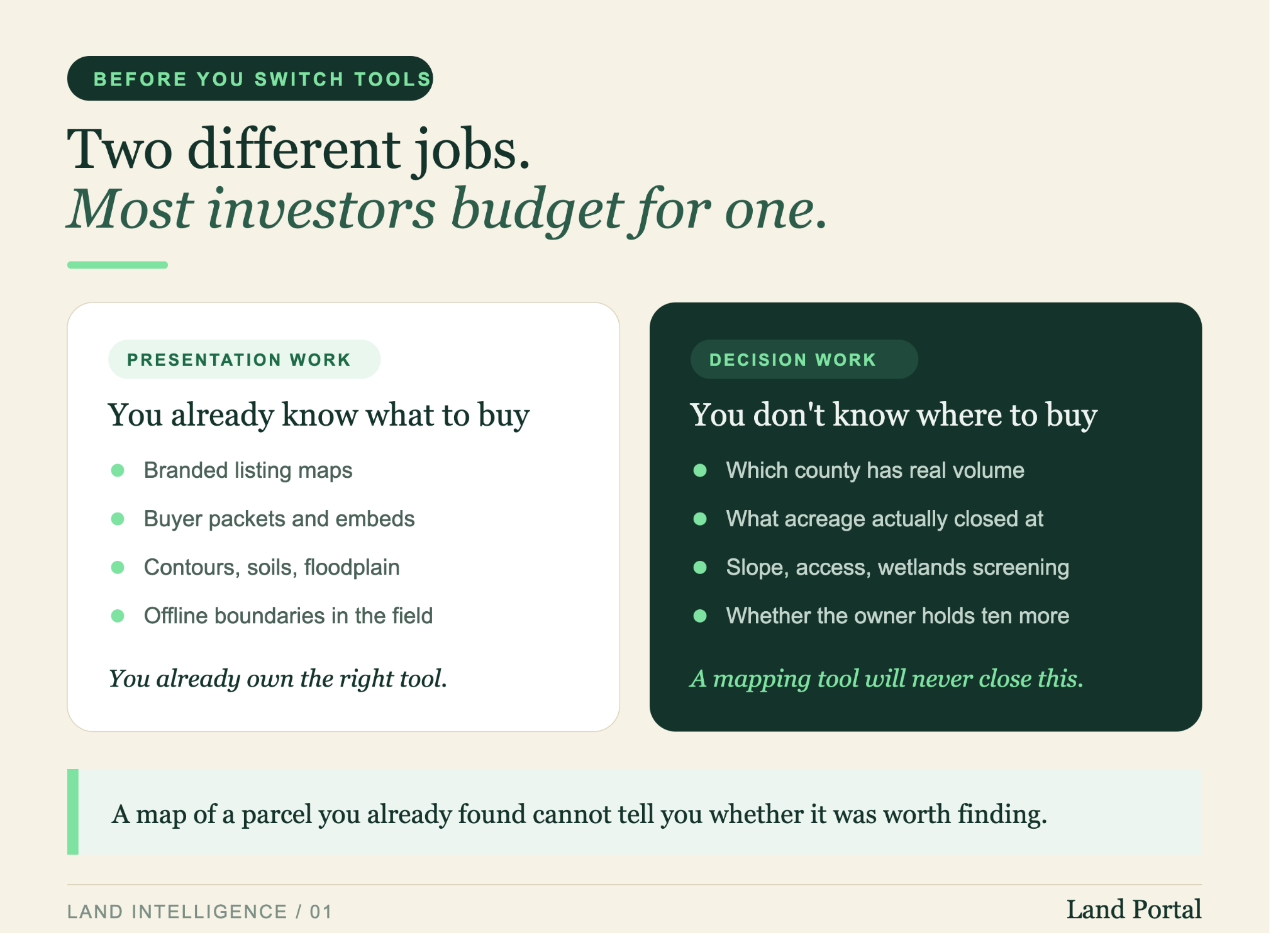
That’s the main distinction to keep in mind throughout this comparison. Some platforms are primarily built to map and present properties, while others are designed to help investors find, research, evaluate, and market to properties.
The right choice depends on which part of that process you actually need help with.
Land Portal
Land Portal is built specifically for land investors and covers a broader part of the investing workflow than a traditional mapping platform.
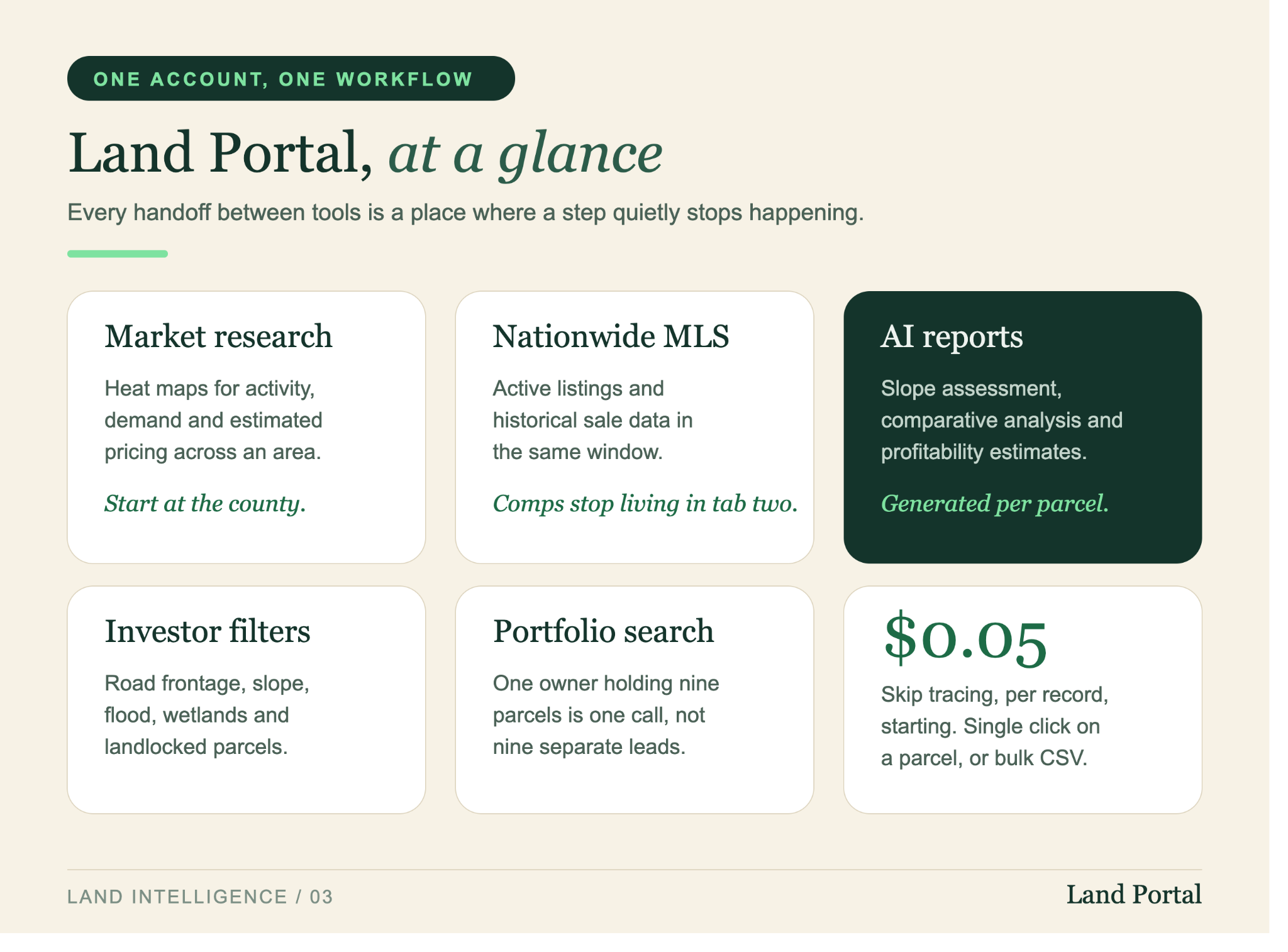
You can use it to research markets, find properties that match your investment criteria, evaluate individual parcels, research owners, analyze comparable land sales, skip trace leads, and prepare lists for direct mail.
One of the biggest differences is the ability to start at the market level rather than beginning with a parcel you already know about. Investors can research areas, compare opportunities, and then move into individual property research without leaving the platform.
Land Portal also includes land-specific property filters for characteristics that matter when buying vacant land, including road frontage, slope, wetlands, flood zones, landlocked parcels, and other criteria that can help remove poor-fit properties before they make it onto a mailing list.
Key Features
• Market research tools for comparing areas and identifying potential opportunities
•Nationwide MLSland comps with active and sold property data
• Land-specific filters including road frontage, slope, wetlands, FEMA flood zones, and landlocked properties
• Property and owner information
• LP Intelligence for AI-powered property and market research
• Portfolio owner search to find additional parcels held by the same owner
• Mapping tools with parcel boundaries, terrain, and other land-specific layers
• Mobile app for property and market research on the go
Pricing
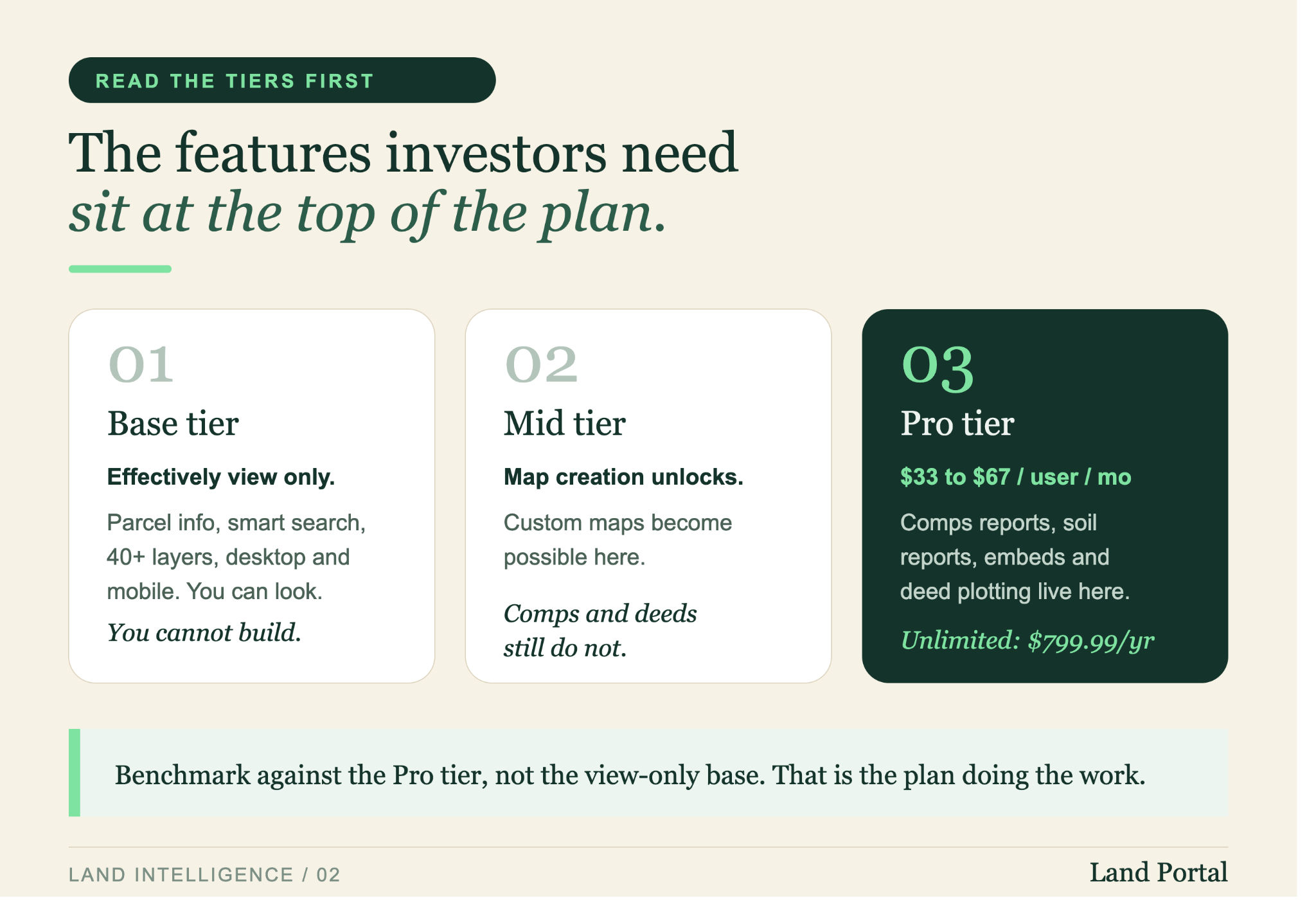
Land Portal offers multiple subscription levels depending on the tools and usage your business needs. Plans start at about $59 per month, with a 7-day free trial and no long-term contract.
Because plans and included features can change, check the Land Portal pricing page for current details before choosing a plan.
Best for: Land investors who want market research, property data, land-specific filtering, comps, owner research, and lead generation in one platform.
PRYCD
PRYCD is focused primarily on helping land investors price properties and lists at scale.
That’s particularly useful for investors running blind-offer campaigns, where every property on a mailing list needs an offer price before the campaign goes out.
Investors can use PRYCD to research land values and apply pricing strategies across larger property lists without manually comping every parcel one at a time.
Compared with Land Portal or Land ID, PRYCD is more specialized. It’s strongest on the pricing side of the workflow rather than serving as a complete mapping, market research, and lead-generation platform.
Best for: Land investors running high-volume or blind-offer campaigns who need to price large property lists efficiently.
Limitation: PRYCD is more focused on pricing than on end-to-end market research, mapping, and lead generation, so some investors use it alongside other tools.
DataTree
DataTree, from First American, is built around property, ownership, title, and recorded-document data.
For land investors, its biggest strength is the depth of information available when researching a property’s ownership and transaction history. It can be particularly useful when you need to dig into deeds, liens, transfers, taxes, or other recorded documents during due diligence.
Key features
• Property and ownership records
• Deed and document images
• Ownership and transfer history
• Lien and judgment information
• Tax and assessment records
Best for: Investors who need deeper title, ownership, and recorded-document research.
Limitation: It isn’t built specifically around the land-investing workflow, so investors looking for land-specific filtering, market research, or campaign tools may need additional software.
DealMachine
DealMachine is primarily built for real estate investors working residential properties, particularly wholesalers and investors using direct-to-seller marketing.
It combines property data, list building, skip tracing, direct mail, and driving-for-dollars tools into one platform.
Land investors can use DealMachine, but many of its workflows and filters are designed around residential real estate rather than the physical characteristics that matter most when evaluating vacant land.
Key features
• Nationwide property data
• List building and owner research
• Skip tracing
• Direct mail
• Driving for dollars
• CRM and lead-management tools
Best for: Investors working both houses and land who want one lead-generation and marketing platform across multiple property types.
Limitation: It doesn’t offer the same depth of land-specific property filtering and market research as a platform built specifically for vacant land investors.
How to Choose the Right Land Investing Platform
The best alternative to Land ID depends on what you’re trying to improve in your business.
Start by asking where your current workflow is slowing you down.
Do you primarily need better mapping and property presentation? Land ID may already be a strong fit.
Do you need help deciding where to invest, finding properties, researching owners, evaluating comps, and building targeted lists? A land-specific research and lead-generation platform like Land Portal may make more sense.
Do you already have your markets and lists but need to price hundreds or thousands of properties? PRYCD may be the more specialized solution.
Do you need deeper recorded-document and ownership research? DataTree may fill that role.
Do you invest heavily in houses as well as land? DealMachine may make sense if you want your lead generation and marketing workflows in one system.
You also don’t necessarily have to choose only one platform. Some land investors use specialized tools together because each solves a different part of the business.
The goal isn’t to find the software with the longest feature list. It’s to choose the tool, or combination of tools, that solves the problems you’re actually running into.