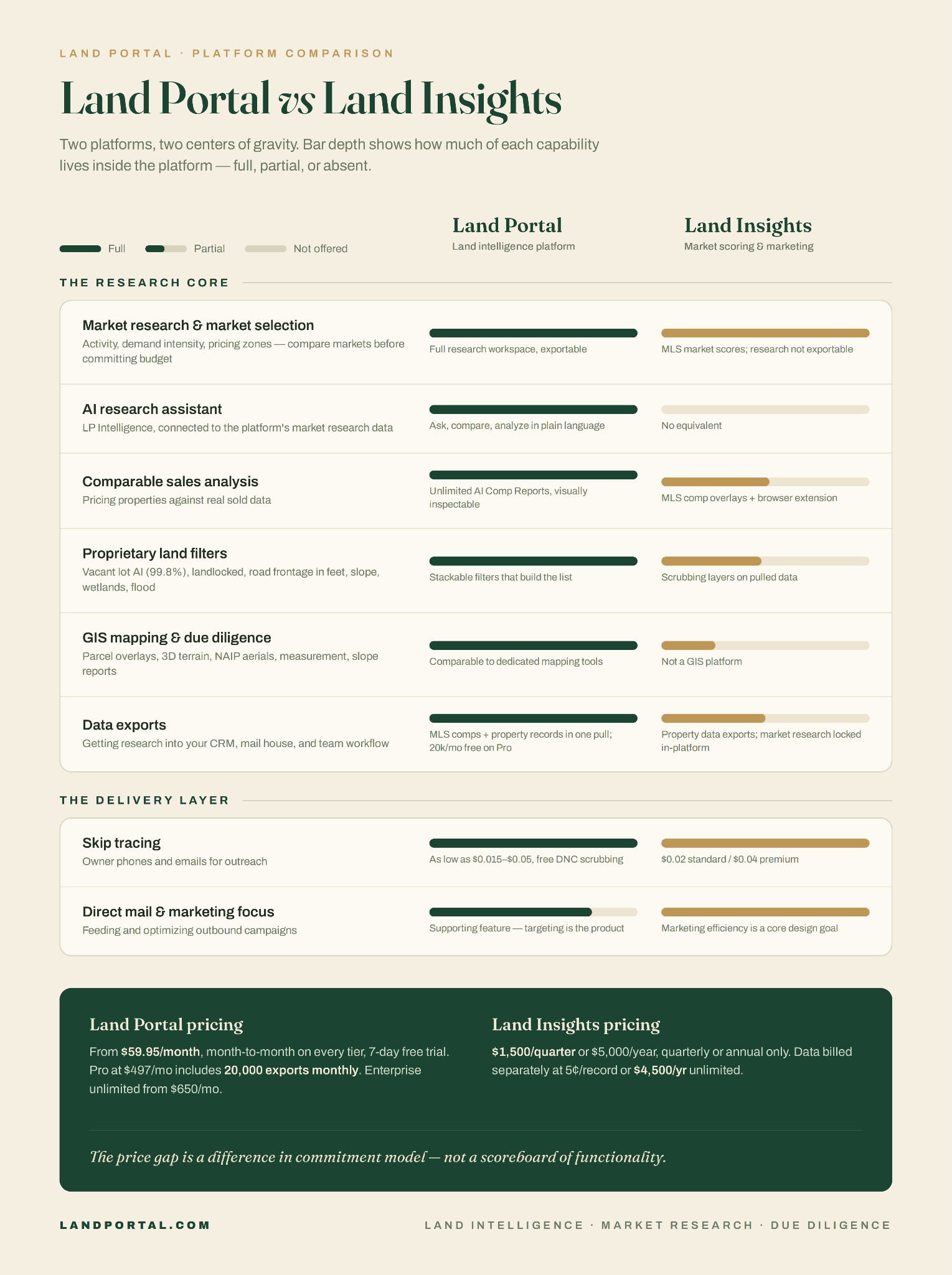
Land Portal vs. Land Insights: Which Platform Is Better for Land Investors?
Land Portal and Land Insights are two of the most popular platforms designed specifically for land investors.
Both help investors research markets, evaluate properties, build mailing lists, and analyze comparable sales, but they take different approaches to those tasks.
This comparison looks at the strengths of each platform, where they overlap, and which type of investor each one is best suited for.
While both platforms support land investors, they were built with different priorities.
Land Insights focuses heavily on market scoring, MLS-based research, and marketing workflows.
Land Portal combines market research, comparable land sales, mapping, AI-powered research tools, land-specific property filters, owner data, exports, and direct mail into one connected platform.
What Each Platform Does
Land Insights is a market research and marketing platform built around MLS data. It pulls listing and sold data from MLS platforms across the country and turns it into market health scores, a “hot or not” read on where land is moving.
There’s a Chrome extension that overlays price-per-acre and market scores on Redfin, Zillow, and Land.com, and a data platform sourced from First American with scrubbing and skip tracing built in.
Subscriptions run quarterly or annually. No month-to-month.
Land Portal is a land intelligence platform that covers the full research-to-decision workflow: a market research suite for evaluating and comparing markets, AI Comp Reports for pricing properties, LP Intelligence (an AI assistant connected to the platform’s market research data), nationwide MLS data, proprietary AI land filters, GIS mapping with due diligence layers, data exports, direct mail support, and skip tracing.
Both platforms will tell you which markets are worth your attention. The difference is what happens after you pick one.
Comparing Market Research Tools
Market research is one of the biggest strengths of both platforms and one of the main reasons investors compare them.
Land Insights approaches market research as scoring:
• Its system grades markets based on MLS activity, what’s listed, what’s sold, and how fast.
• The output is a score, and the pitch is speed: identify a good market in seconds instead of spending a weekend in spreadsheets.
For a lot of investors, that’s genuinely useful. Days-on-market and absorption tell you a lot.
Land Portal approaches market research differently:
Its market research suite lets you look at market activity, demand intensity, and pricing zones across specific areas, drill into what’s driving them, and compare markets against each other before committing budget.
Instead of relying primarily on a market score, investors can review market activity, pricing zones, demand trends, and comparable sales data together before deciding where to invest their marketing budget.
That additional context can make it easier to understand why one market may be a better fit than another.
LP Intelligence allows investors to ask questions about the same market research data available inside the platform, making it easier to compare markets, analyze properties, and organize research.
Another difference is how research data is used after analysis.
Investors should consider whether they need to export research results into other systems or primarily work within the platform itself.
LP Intelligence
One feature unique to Land Portal is LP Intelligence, an AI-powered research assistant connected directly to the platform’s market research data.
Instead of manually navigating reports and dashboards, investors can ask questions about markets, compare counties, review parcel information, and analyze comparable sales using the same research data already available inside the platform.
The goal isn’t to replace investor judgment, but to make research faster and easier.
Land Comping and Property Valuation
Land Insights overlays MLS sold, pending, and active comps inside its data platform, plus the Chrome extension for on-the-fly price-per-acre while you browse listing sites. It works, and users like it.
Land Portal’s AI Comp Reports go a step further:
• Automated comparable sales analysis that compares a property against similar listings and sold data to estimate current market value.
• And the ability to click into each comp and inspect it visually.
One advantage of visual comparable sales analysis is that investors can review each comparable property alongside mapping and parcel data.
Because vacant land values are influenced by factors such as access, terrain, wetlands, and utilities, reviewing comparable properties visually can provide additional context before making pricing decisions.
Property Data, Filters & Exports
Both platforms source strong data.
Land Insights uses First American. Land Portal maintains its own nationwide property dataset with daily updates and MLS data integrated, and it’s one of the only platforms where you can export MLS comps together with standard property records in one integrated pull.
Land Portal includes proprietary land-specific property filters that allow investors to narrow lists using characteristics such as vacant land detection, road frontage, slope, wetlands, flood zones, acreage, and legal access before exporting records.
Land Insights offers scrubbing across similar categories, de-duplication, wetlands, flood, landlocked, road frontage, slope, as part of its data workflow, and it’s a real strength of their platform.
These filters are designed to help investors identify higher-quality acquisition opportunities before building mailing lists.
Both platforms offer property exports and data services. Investors should compare each platform’s current pricing and export structure based on their expected usage.
Mapping and Land Due Diligence Tools
Both platforms include mapping capabilities, but they emphasize different workflows.
Land Portal includes parcel boundaries, terrain analysis, road frontage tools, aerial imagery, slope reports, measurement tools, and due diligence layers within one mapping interface.
Land Insights focuses more on integrating market research and comparable sales into its workflow rather than providing a full GIS-style mapping experience.
Direct Mail and Skip Tracing
Both platforms include skip tracing and direct mail capabilities.
Land Insights places greater emphasis on marketing workflows, while Land Portal positions these features alongside its market research and property evaluation tools.
Investors should consider which workflow better matches the way they acquire properties.
Pricing
Both platforms offer multiple subscription options and different pricing structures.
Rather than focusing only on subscription price, compare how each platform aligns with your workflow, data needs, export volume, and long-term business goals.
Because pricing and features change over time, review each company’s current plans before making a decision.
Which Platform Is Right for You?
Both Land Portal and Land Insights provide valuable tools for land investors, but they are designed around different workflows.
Land Insights is a strong choice for investors who prioritize MLS-based market scoring and marketing efficiency.
Land Portal combines market research, comparable land sales, mapping, AI-powered research, land-specific property filters, owner data, exports, skip tracing, and direct mail into one connected workflow designed specifically for land investing.
The best platform depends on how you research markets, evaluate properties, and manage acquisitions. If possible, test each platform using a market you already know before making a long-term decision.