


Log in
PropStream Alternatives for Land Investors:
What to Use Instead (and Why)
For house flippers and wholesalers working residential deals, PropStream does what it promises: ownership data, comps, skip tracing, list building, all in one place.
The problem shows up when you point it at vacant land.
PropStream was built for house people. Its filters, its comps logic, its motivated-seller indicators all assume there’s a structure on the parcel. Pre-foreclosures, high equity, tired landlords.
Useful signals if you’re buying houses. Mostly noise if you’re mailing rural landowners about a 12-acre parcel with no driveway.
This article breaks down where PropStream falls short for land specifically, then walks through six alternatives worth considering: what each one actually does well, where it falls apart, and who it fits.
How we evaluated these tools?
We compared each platform for filtering, compiling, and skip tracing. Our focus was on vacant land deals, not house-flipping workflows. We based our assessment on hands-on use of each platform’s current public plans and documented features. Pricing and features can change. So, we suggest checking with each vendor for current plans before you buy.
Where PropStream Falls Short for Land Investors
Land investors run into the same friction points again and again.
You can’t filter out landlocked parcels, so your mailing list is padded with properties nobody wants. There’s no road frontage filter, no slope data, no wetlands screening.
1. Land Portal
Land Portal is the most direct answer to the question, because it’s the rare platform built by land investors for land investing specifically, rather than a house tool with land bolted on.
The difference is obvious the first time you pull a list.
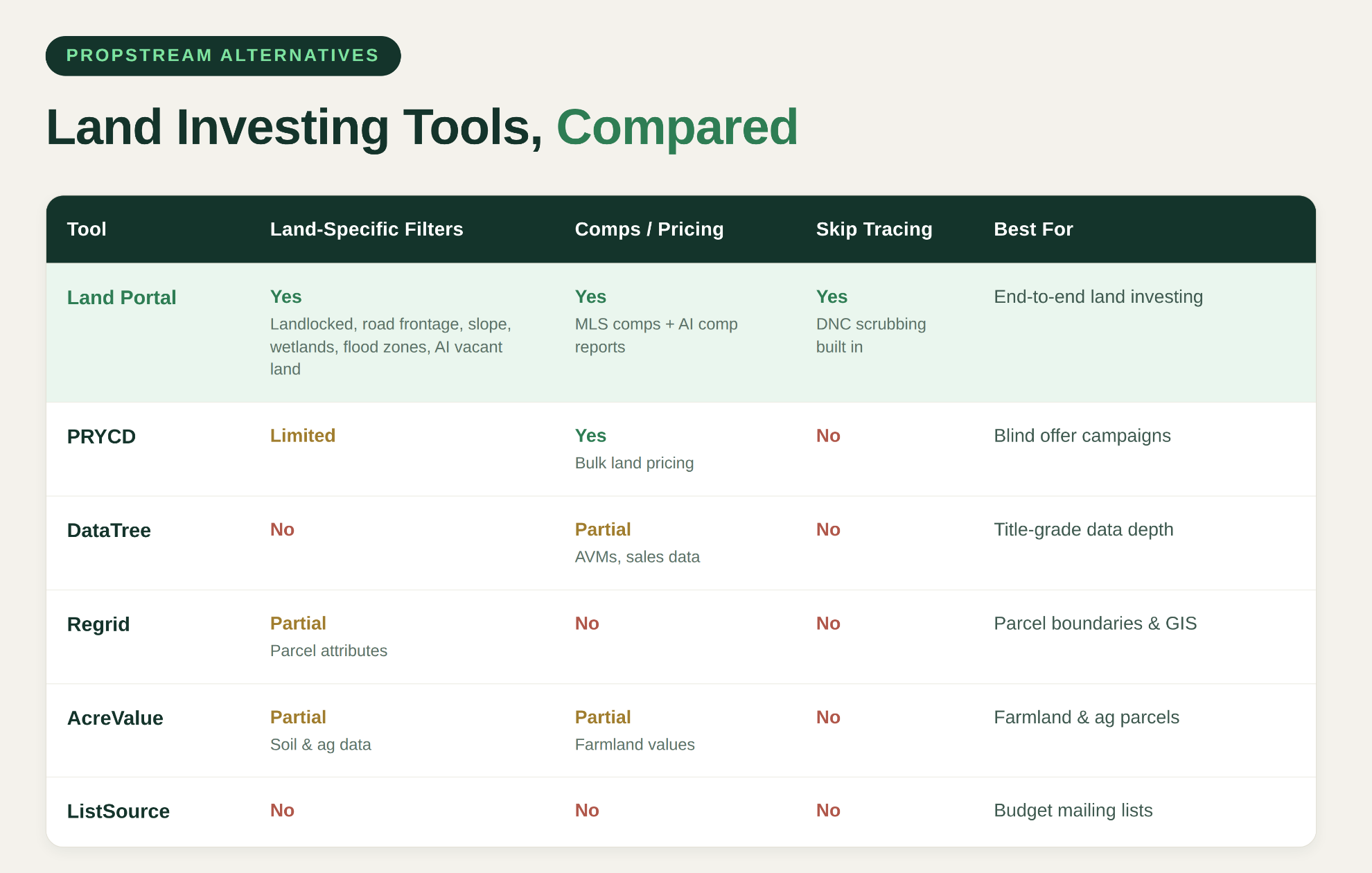
Land Portal’s filters address the exact problems that make PropStream frustrating for land: an AI-powered vacant land filter, a landlocked filter, road frontage targeting by minimum and maximum feet, wetlands screening, slope filters, FEMA flood zone data, and even water features such as ponds and creeks. In practice, that means you eliminate the junk parcels before you pay for a single record, not after your mail comes back undeliverable or your calls go nowhere.
That filtering-first approach changes the economics of list building. A landlocked, wetland-covered parcel doesn’t just fail to convert; it costs you data fees, skip tracing, postage, and follow-up time. Removing those parcels at the filter stage is where the savings actually compound.
Beyond list building, the platform covers the rest of the workflow: nationwide MLS comp data for pricing, AI-generated comp reports, skip tracing with DNC scrubbing built in, contour lines and parcel overlays on the map for eyeballing terrain, and batch exports for mailing campaigns. There’s also a mobile app, so you can continue researching markets and reviewing properties wherever you’re working.
For investors comparing capability options rather than brand recognition, this is the closest thing to purpose-built the land niche currently has, and a strong contender for the best land software available right now.
Best for: Land flippers and land investors at any scale who want land-specific filtering and an end-to-end workflow in one tool.
Land Portal’s plans begin at about $59 per month. They offer a 7-day free trial and no long-term contract. You can find details and current pricing on the Land Portal plans page.
2. PRYCD
PRYCD approaches the land business from the pricing side. Its core strength is comping and pricing vacant land at scale, which is genuinely hard to do well because land comps are sparse and inconsistent compared to houses.
Where PRYCD earns its keep is blind offer campaigns. If your model is mailing offers rather than neutral letters, you need a defensible price on every parcel in the list, and PRYCD’s pricing data is built for exactly that. It also offers data exports and research tools.
The trade-off: it’s a pricing and data tool more than a full platform. Many investors pair it with a separate mapping or list-building tool rather than using it alone.
Best for: Investors running blind offer campaigns who need bulk pricing more than mapping or filtering.
PRYCD uses a subscription model that starts at about $25 a month or roughly $500 a year. It offers a 14-day free trial.
3. DataTree
DataTree, from First American, is the heavyweight data option. It’s a title-industry tool at its core, which means the ownership records, document images, and property data run deep. If you need recorded documents, deed history, or unusually reliable ownership chains, this is where the professionals go.
The catch is that DataTree was never designed for land investors specifically. There are no landlocked or road frontage filters. Building a clean land mailing list takes more manual work, and the interface reflects its title-company DNA rather than an investor workflow.
Best for: Investors who prioritize data depth and document access over land-specific filtering, or who already use it for title research.
4. Regrid
Regrid is the parcel data specialist. Its nationwide parcel boundary dataset is one of the best available, and its mapping tools are clean and fast. For investors whose work leans heavily on parcel geometry, boundaries, and GIS-style analysis, it’s a strong option, and its data powers plenty of other tools behind the scenes.
What it isn’t is a deal-sourcing platform. Skip tracing, motivated-seller logic, and campaign workflows aren’t the focus. Think of it as excellent infrastructure rather than an end-to-end investing tool.
Best for: Data-oriented investors and teams who want high-quality parcel boundaries and mapping, and are comfortable assembling the rest of the stack themselves.
5. AcreValue
AcreValue comes out of the agricultural world, and it shows in the best way for certain deals: soil quality data, crop history, and land value estimates oriented around farmland. If your acquisitions lean agricultural, it surfaces information most investor platforms simply don’t carry.
For general land flipping, though, it’s a supplement rather than a base. The deal-sourcing and campaign tools are limited compared to investor-focused platforms.
Best for: Investors working farmland or ag-adjacent parcels where soil and productivity data drive value.
6. ListSource
ListSource is the old workhorse of direct mail list building, drawing on CoreLogic data. It’s straightforward: define criteria, buy a list, mail it. No mapping, no comps, no skip tracing, just lists.
Plenty of land investors have built businesses on ListSource lists. But the filtering is generic real estate filtering, so the same landlocked-and-wetlands problem applies: what you save on the tool you often give back in wasted postage on parcels you’d never buy.
Best for: Budget-conscious investors who only need raw mailing lists and are willing to accept less refined targeting.
How to Choose the Right Platform
Strip away the feature checklists and the decision comes down to three questions.
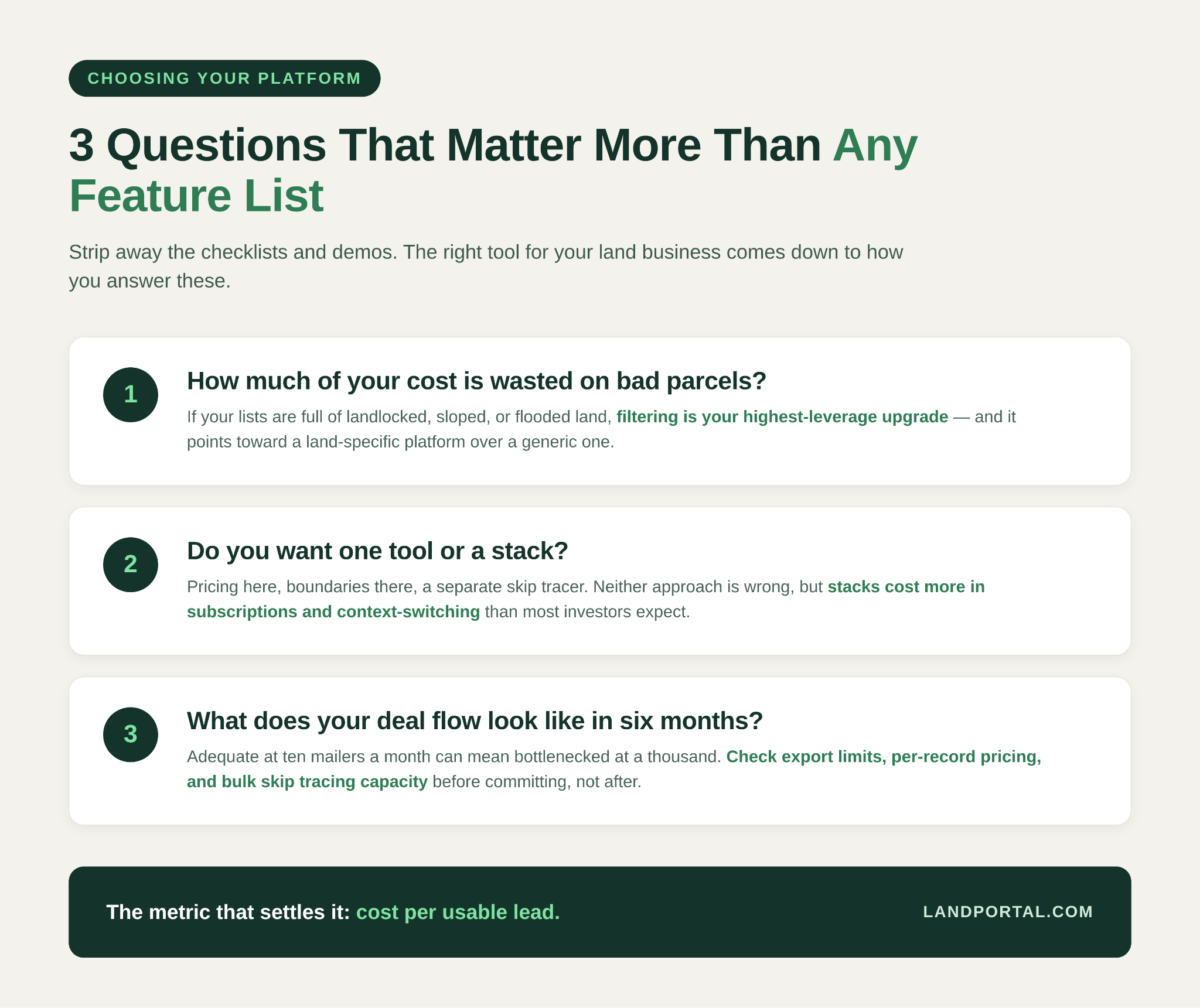
First, how much of your cost is wasted on bad parcels?
If your mailing lists are full of landlocked, sloped, or flooded land, filtering is your highest-leverage upgrade, and it points you toward a land-specific platform over a generic one.
Second, do you want one tool or a stack?
Some investors happily run PRYCD for pricing, Regrid for boundaries, and a separate skip tracer. Others want everything in one login. Neither is wrong, but stacks cost more in both subscription costs and context switching than people expect.
Third, what does your deal flow look like in six months?
A tool that’s adequate at ten mailers a month becomes a bottleneck at a thousand. Export limits, per-record pricing, and bulk skip tracing capacity matter more as you scale, so check those numbers before committing, not after.
PropStream will continue to serve house investors well. But land is its own business, with its own data problems, and the tools built for those problems will beat a general-purpose platform on the metric that actually matters: cost per usable lead.
The Bottom Line
The alternatives above each solve a piece of the problem, and one or two solve most of it. Try one alongside your current workflow for a few weeks and compare the quality of your leads, not just the number of them.
Start with the question of wasted spend: if your lists are full of parcels you’d never buy, a land-specific platform like Land Portal pays for itself before the first deal closes.
Test one against your current workflow for a month and let the response rates settle the argument.

Your Premium Source For Real Estate Data
© Copyright 2026 Land Portal – All Rights Reserved